Showing posts with label The People You Meet. Show all posts

Mar 5, 2019

The People You Meet Along The Way: Life is what happens while you're busy making other plans...

Life, they say, is what happens while you’re busy making other plans. I don’t know about you, but it feels like everyone’s ‘busy’ making plans these days. I’ve recently even caught myself hopping on the ‘I’m so busy’ band wagon wondering how I'm going to fit everything on my 'to-do' list into a day. 

There’s a popular meme that goes, ‘You have as many hours in a day as Beyoncé.’ Whether you like Beyoncé or not, what the core message boils down to is that we all get the same amount of time - not the same circumstances or level of assistance - but we all get the same 1,440 minutes every single day. The difference between your life, or mine, or Beyoncé’s is defined by what we choose to do with those minutes. It’s up to us to carve out the time to make our own ‘bootylicious’ stuff happen. This involves honing in on why, what and where our priorities are, focusing on planning and time management, and building our 1,440 minutes around that.

I can almost hear parents around the world groaning that I’m venturing to write a blog about “planning” and “time management” in the same breathe as a reference to a Beyoncé meme - particularly as I think back to my youth and the herculean level of planning that my parents deployed in managing our family. Growing up, life was meticulously broken down into an orchestrated time-boxed schedule of school drop-offs, pick-ups, piano, ballet, gymnastics, badminton, soccer, grocery shopping, full-time jobs, after-school jobs etc. D-Day did not receive the level of planning as was scratched onto the calendar hanging in our family kitchen.  To all you parents out there (especially you Mom) – chapeau. I have no idea how you do it.

I don’t have to worry about school drop-offs and pick-ups but I do have a full time job, and live a life directed by commitments, choices and decisions – some of these are mine, some are not. I’ve spent nearly two decades shaping a career as a consultant harmonized with an inherent sense of wanderlust and sprinkled with a touch of “fear of missing out”. Like you parents out there, I’m learning – through trial and error – the art of multi-tasking, learning when to say ‘yes’, when to say ‘no’, and smiling bravely through the realisation that there are 24 hours in the day and I've planned for 30. These are the ‘not so bootylicious’ evenings that I’m in the gym after a long day in the office, gasping for breath on a treadmill while reading emails and deciding what to reheat in the microwave for my 11pm dinner.

Here’s a recent example. In April I’m traveling to Nepal to climb a 6100m / 20295ft mountain and volunteer for a charity to help put the finishing touches on the building of a local climbing school. As I’ve spent the past few months diligently planning and managing the activities around the trip, I can’t help but reflect on my first visit to Nepal about 20 years ago. I packed a ‘you only live once’ mentality along with a small backpack, begged and borrowed for the flight ticket, kissed my parents good-bye and off I went. How things have changed. 

Now that I’m older and ‘busier’ with commitments involving suitcases with wheels more so than backpacks, it’s more a case of making choices about what I truly want to do and why. I consider how I can carve a chunk of time to do it, and then come up with a plan that fits into that time slot that doesn’t compromise my objectives or the intimacy of the experience. This means bypassing the all-inclusive margarita-themed holidays to Punta Cana and focusing instead on preparing for the adventure I’m saying ‘yes’ to.  Sounds simple right? Ha.

I’ve wanted to go on this trip Nepal for a number of years but other priorities moved it to the back-burner. This year I spent time speaking to family, friends and colleagues to figure out how to prioritise the time out to plan the trip and set the wheels in motion make it happen. 

Managing work, personal commitments, relationships, fitness, finances, and taking time out for myself - there are a lot of 'moving parts' and it's been easy to become overwhelmed. As tempting as it is, I’m not going to give you the “sunshine and unicorns” version of this story. I have been overwhelmed. Crippling anxiety, moments of defiance and stubbornness that exacerbate every negative Taurean trait running through my body. Questions like, “Have I made the right choices?” “How can I make the time?” These are the moments that challenge me, that I learn from and that keep me true to my purpose and passion-led ambitions. 

But here’s the harsh reality. There is no simple solution to making more time. I can’t solve your lack-of-time conundrum – it’s entirely down to you. But I might get you excited enough to resolve to solve it yourself. To set your plan in action and kick-start the conversations with the people in your life – your family, your colleagues, yourself – about how it might be possible to pause the racing rhythm of life for long enough to plan do something different and memorable that satisfies and rewards in equal measure.

For your treadmill reading pleasure, here are four quick reflections from my own experiences in deciding what stays on the calendar and what goes… and how to manage all the bootylicious stuff that happens in-between.

Discipline: Be disciplined in your focus on attaining your goal.

A focus on the end goal is a bit like having a personal GPS. Once you type your destination into a GPS, it cleverly spits out step- by-step details in how to get there. If only there was a GPS of life – but that would take out the adventure wouldn’t it?  I’ve learned to manage goals by breaking key activities and events down into priorities: What needs to be done today? What can wait until tomorrow? What can wait until next week? A therapeutic 15 minutes is spent every morning prioritizing so I know what’s on my plate for the day ahead. There are plenty of apps (e.g. Toggl, Workflow, Shift, RescueTime) that can help with this if lists aren’t your forte. I keep it simple and use the ‘Notes’ app on my phone and a good old-fashioned pen and moleskin notebook. My recommendation – find a simple solution that works best for you and stick with it.

Before every expedition, I spend time thinking about my end-goal and the detailed activities and steps (real and proverbial) required to achieve it. “Is it the summit? Is it to raise money for a particular charity? Is it to improve my skills and fitness? Is it to experience a new part of the world?” I write down the activities required to achieve the goals in a step-by-step list. As a highly skilled procrastinator I’ve found that without this rigor and focus I’m easily distracted and diverted - the dishes in the sink, the floor that needs vacuuming or the trip to the grocery store that just can’t wait. Just as road congestion and construction requires the GPS to recalibrate, I’ve learned that my daily ‘to do’ list helps me to keep sight of goals and focused on the steps to get there irrespective of the detours that pop up along the way.

Commitment: Don’t give up when you’re forced beyond your comfort zone or when setbacks or disappointments happen.

There's a difference between interest and commitment. When you're interested in doing something, you do it only when it's convenient. When you're committed to something, you accept no excuses; only results.” A great quote by author Ken Blanchard.  

If I was only ‘interested’ in climbing mountains (assuming this was my goal), I’d deprioritize training, planning, and expedition preparations, only focusing on climbing when it was convenient. I’d give up on the goal with my first shiver in the freezing temperatures or the first rain on a training run. Commitment to a project like climbing a mountain means that even when exhausted from a long day of work, I still go to the gym for the days training or I continue with my run despite torrential rain. It might not be the most productive training session of all the time but it’ll do wonders in keeping me relentlessly focused on my end goal - even when things get uncomfortable.

Those people who are successful in the mountains – and in life more broadly – are those who are unrelenting in the pursuit of their goal. Sure they experience setbacks and failures like everyone else, but what sets these people apart is their ability to get back on track and learn from their mistakes. Success and commitment to achieving a goal is about the ability to do this time and time again.

An example is the incredible story of the 69-year old Chinese double amputee Xia Boyu. Last year Mr. Xia summited Mount Everest on his fifth attempt. In 1975, his team were trapped in a storm near the summit. He lent a teammate his sleeping bag and subsequently suffered severe frostbite, losing both his feet. 1996, he was diagnosed with lymphoma and, after recovering from cancer, he attempted to summit Everest three more times…. In 2014, the climbing season was cancelled due to an avalanche on Everest. His attempt in 2015 was called off after the Nepal earthquake. Then in 2016, Mr. Xia's dream seemed within reach - the team was just 300ft from the summit when a blizzard forced him to turn back… Then last year in May of 2018, on his fifth attempt, Mr. Xia achieved his dream of reaching the highest point on earth and becoming the second double amputee to ever do so. It’s an incredible example commitment and the relentless pursuit of a goal.

Courage:  Learn to say ‘no’.

Learning to say ‘no’ takes courage. Saying no is one the most challenging things I’ve had to learn in harmonizing a career and personal ambitions outside of work. Over the past few years, I realized that my people pleasing tendencies were creating stresses and inefficiencies which were impacting my work, personal life and the enjoyment of time spent outdoors. Thanks to some great coaches and simple exercises in knowing when to say ‘yes’ and when to say ‘no,’ I've begun to preserve my most valuable resource – time – while growing personally and professionally. By saying ‘no’ to some things, I’ve realized that I’m actually saying ‘yes’ to other things – for example, a step toward a professional or mountaineering goal. Saying ‘no’ to a new commitment honors your existing commitments and gives you the opportunity to successfully fulfill these commitments.

There are literally thousands of articles and books written on different ways to say ‘no’ and offering tips and tricks to help convert your ‘no’ into a ‘yes’. A few highlights include:
  • Value your time. Know your commitments, and how valuable your time is. Then, when someone asks you to dedicate some of your time to a new commitment, you’ll know that you simply can’t do it. And be upfront in sharing that – don’t wait until the last minute.
  • Know your priorities. If you do have some extra time, ask yourself whether this new commitment is how you want to spend that time? If it’s not, then say ‘no’. Pretending you can do everything in equal measure creates artificial pressure and ignores the pleasure of impassioned action and discipline. There’s a lot to be learned from giving some things up and giving your all to what you love.
  • Practice saying no. Practice makes perfect. Saying ‘no’ as often as you can is a great way to get better at it and more comfortable with saying the word – it’s actually quite empowering.

Creativity: Look for ways to overlap things.

Asking for the time off to climb Everest was a nerve-wracking experience. I’d already considered all of the reasons why my boss might say ‘no’ and hadn’t considered why he might say ‘yes’. As it turned out, he was an ‘arm-chair adventurer’ and connected with the vision behind my request. We spent the rest of the meeting discussing the leadership qualities of adventurers like Shackleton and how these qualities aren’t dissimilar to those we see exemplified by some leaders in business today. We talked about discipline, commitment and courage inside and outside of the office. My boss suggested that I present at a team meeting on ‘leadership lessons learned’ following my expedition. I obliged and a few months later  was amazed at how much I’d learned from my experiences - the preparation, expedition logistics, and the challenges we faced individually and as a team.

I started building a portfolio of ‘lessons learned’ on a range of topics including team building, objective setting, risk management, decision making, communications, reframing success, and leadership. Rather than seeing the time-off work as a ‘career limiting’ move, it became ‘career enhancing’, gave me confidence, independence and purpose. It tapped into my love of story-telling, adventure and problem solving - and I became a more authentic, effective consultant as a result.

A few years later I organised a trek of Mt. Kilimanjaro in Tanzania to support one of our firm’s Foundation charities and as a continuation of my goal to creatively harmonize my personal and professional interests. The expedition raised $40,000 to support a charity funding critical research into issues impacting the health and wellbeing of women and babies. The news of our success spread across the firm. Today, five years, later I’ve organised multiple Kilimanjaro treks and have also added Everest Base Camp to the charity challenge portfolio. We’ve raised nearly $400,000 for our Foundation charities, are on-track for another $150,000 this year and have a waiting list booking into 2021. Equally importantly, over 100 colleagues have become friends, have learned about fundraising and have experienced a great adventure together, forging friendships and memories that will last a lifetime. A bit of creativity and a passion for bringing colleagues together to learn from each other in an environment far removed from the office has been more fulfilling than I ever dreamed possible.

Choices and priorities - one month to go…

Over the past few weeks I've consciously reminded myself to breathe – to inhale, exhale, repeat - revisit the to-do-list, re-baseline dates, re-prioritise and let my body catch up with my brain. I’ve focused on deciding what things on my list relate directly to achieving my goals and which are just ‘nice to haves’. I’ve realised that this discipline and rigor are critical in this so that I don't find myself on a mountain without a sleeping bag or return from an expedition without a job.

One of my most valuable learnings has been the appreciation that everything I do – every choice I make, every activity I prioritise - has a cost and consequences. I'm learning that life isn’t ever going to be perfect. I’m never going to be entirely ready, there is never an entirely ideal time, not every problem can be completely resolved and fear and anxiety never entirely leave. But it’s down to me – to you – to make the choices on how to live a life fulfilled. Inevitably, I’ll still find myself having those not so bootylicious OMG moments, reading emails on the treadmill and reheating microwave dinners at 11pm… But thinking back to our well-used family calendar, the sooner I make peace with this basic fact, the better I’ll be at making decisions that work for me. It’s entirely down to me to build the life I want to live today. And that’s an incredibly empowering realisation.


Feb 26, 2019

SPRING 2019 CLIMBING PLANS: A Tale of Two Mountains...

Mountains. Looking back on journeys to these wild places and looking ahead to those to come, I wonder why I'm drawn to their rocky, snowy slopes and why I consciously succumb into their folds. Is it the unharnessed, unpredictable wildness of these places in a world that feels increasingly 'pre-meditated, staged and controlled'? Is it the people I meet along the way – their hardy, weather-beaten faces etched with signs of a life lived raw and rugged, welcoming me into their private sanctuaries and personal narratives? Or is it the ego that pulls me higher and higher? Would I still climb if there was not that 'lure' to share the triumphs and tribulations - for whatever reason or purpose?

I’ve realized there’s no simple answer - yet this hasn’t stopped the search for an altruistic justification between ‘purpose’, ‘passion’ and ‘ego’. For me, these questions are the kindling to self-awareness and reflection – the physical mountains providing the spark for the fire. 

It’s the entirety of the journey to these wild places that fuel me. The lure of the unknown, of possibility, of growth, adventure, the intimacy of experience, the connection to nature and the people I meet along the way. These journeys provide me with perspective. I’m reminded that I’m small, insignificant and vulnerable. My ego crumbles, and my perspective expands. Living completely in the moment, the borders between myself and my surroundings appear to dissolve; I feel sunsets instead of simply seeing them. On these journeys, an unexplainable peace fills me - elusive, indefinable. And I recognize how I fit into the world. 

I look forward to returning to the Himalayas this spring. An alignment of passion, purpose and circumstance has helped shape the bones of journey that brings together those elements that drive me to pursue a life that challenges and rewards in equal measure. 

Namaste Nepal – it’s time for our journey to continue once again…

Chapter I: Ego and Passion

Kyajo Ri…

In the Khumbu Himal, running just north of the Sherpa capital of Namche Bazaar, is a long line of peaks continuing all the way to Cho Oyu on the Nepalese-Tibetan border. With the Thame valley to the west and the Gokyo valley to the east, Kyajo Ri, at 6186 meters (20,295 feet) is the highest summit on the southern part of this ridge. It’s the highest peak in the immediate vicinity and doesn’t take a broad stretch of the imagination to recognize the potential for unparalleled views of the Himalayan panorama from its snowy triangular summit.

Kyajo Ri was opened to climbing by the Nepalese Ministry of Tourism, in 2002 and the first (official) ascent was made that year by a French/British team. They approached from the village of Machermo, traversed the Kyajo Glacier and climbed via the Southwest Ridge. Whilst the mountain is now climbed regularly both commercially and in alpine style via several different routes, it remains a relatively quiet objective with only a few teams found on its flanks each season. It remains overshadowed by the more popular commercial peaks of Ama Dablam and Island Peak. 

Not an unfamiliar face…

I was on Kyajo Ri in the Autumn of 2011 climbing in alpine style with American-Italian alpinist Fabrizio Zangrelli. It was a training expedition focused on honing my mountaineering skills and building confidence and agility in the mountains. Kyajo Ri was an excellent peak to help meet these objectives. It’s a technical mountain without being extreme – the route free of fixed rope and anchors and retains its pristine wild condition. Fabrizio and I climbed from the ‘Machermo side’ via the southwest ridge but did not summit, turning back at Camp 2 due to unstable “sugar snow” conditions. The decision was prudent. We woke the following morning to the ominous beat of rescue-helicopter blades cutting the air and learned that the small Russian team ahead of us had tragically fallen from the ridge and lost their lives. Our descent and retreat to the comforts of Machermo was inevitable and we trekked across the Khumbu for a quick ascent of Island Peak to make the most of our acclimated bodies, soak-up the beautiful views, burn-off calories from bottomless plates of momos and the enjoy company of the local people and trekkers passing through the region.

This April I return to Kyajo Ri, climbing alpine style from the ‘Mende side’ and in the company of New Zealand based IFMGA / NZMGA mountain and ski guide, Mal Haskins. I met Mal in the dust of the relief efforts of the 2015 earthquake and we’ve since kept in touch sharing climbing projects and objectives. Earlier this year I mentioned my desire to return to Nepal to climb a ‘non-8000er and non-uber commercial’ mountain with the caveat that it had to be ‘interesting and fun’. His suggestion of Kyajo Ri ticked all the boxes.  

Background and context…

My most recent journey to Nepal and into the mountains of the Khumbu was in the Spring of 2017 – a trip driven largely by a desire to overcome ‘mental barriers’ which had emerged following my experiences in the 2015 earthquake. Balanced between moving from the UK to Canada, working with several not-for-profit organizations, climbing Lobuche Peak, and spending time with the High Altitude Worker Teams as they prepared Everest Base Camp for the climbing season, it was one of the most personally fulfilling trips I’ve ever had. I returned to sea level revived, humbled and fully in-tune with a sense of purpose. Whilst my love for Nepal had never subsided in the aftermath of the earthquake, my confidence certainly had and I was overcome with a sense of relief that the mountains and their people that I’d felt such a connection to, again felt like home. With my ego back in check and purpose aligned, I knew that my narrative with the country was far from over.

In the Autumn of 2018 my social media feeds were inundated with the inevitable post-monsoon Himalayan ‘mountain porn’. I found myself looking east once again. 

I look forward to returning to Nepal this Spring and have been going through the all-too familiar motions in trying to strike a precarious balance between preparing for an expedition and meeting the professional commitments of a full time job in an industry far removed from the mountains. With discipline, commitment, courage and creativity things are falling into place – and with an early April departure, the countdown is now well and truly on. 

Chapter II: Passion and Purpose

The Khumbu Climbing Centre

High in the Himalaya and deep in the heart of the Khumbu valley just off beaten track to Everest, there’s a quiet pastoral village called Phortse perched at 4,000 meters (13,000 feet) among the clouds, overlooked by the iconic west face Ama Dablam, and in the shadow of the holy peak, Khumbilia. 

In October 2012 our expedition climbing team spent a few days in Phortse enroute to climb Ama Dablam. Trekking uphill into Phortse in the warm afternoon sunshine from the gaping gorge of the Dud Kosi river, we were treated with our first glimpse of the terraced fields, yak dung drying in the sun, humble stone houses, a rolling birch forest, grazing yak and seemingly endless views of the Khumbu. As someone living in the cacophonic chaos of a modern western city, the gentle and spiritual nature of the village felt surreal and perfectly idyllic. 

Walking into Phortse, the characteristic ‘tap-tap-tap’ of masons at work and the faint rumble of a drill broke through the air, mixed with the grunts of the yaks roaming in the terraced fields. The orchestra of the Khumbu. The source of the sound was a group of local and western builders and masons led by Tim Harrington. They were thoroughly absorbed in their trade huddled over a large plank of wood laid on an impressive foundation of a building in early stages of construction. It was my first view of the Khumbu Climbing Centre (KCC)

Given my penchant for outdoor building projects, (thanks Dad!) my imagination was captured and I felt a hankering to roll-up my sleeves and get involved.  We spent a thoroughly enjoyable few days at the KCC enjoying the company of the builders and lodge guests, learning about the ups and downs of carrying out an ambitious project in the heart of the Khumbu. A labor of love in all respects.

History: Building and fostering a responsible climbing community in the heart of the Khumbu 

On a visit to Phortse in Nepal 2002, Jenni Lowe-Anker and her husband Conrad Anker were struck by how much the Sherpa guiding community craved a chance to develop better technical skills, both for professional advancement and, to put it bluntly, avoid getting killed. 

Statistics showed that a staggering one third of all deaths on Everest were Sherpa and few had the skills that would help to keep them and their clients safe in the mountains. Under the vision and leadership of Jennie and Conrad and with the support of a broader community who recognized the importance of keeping people safe in the mountains, The Khumbu Climbing Center was launched in 2003. Its mission: to increase the safety margin of Nepali climbers and high-altitude workers by encouraging responsible climbing practices in a supportive and community-based program. The goal was not only to teach technical hard skills, but also to promote climbing for fun.

Since its inception, it’s become a successful vocational program for indigenous people and has served nearly one-thousand Nepali men and women. Each winter technical climbing skills are taught along with English language, mountain safety, rescue, and wilderness first aid. In its early stages, instructors were qualified western climbers and guides who had experience in the Himalaya. Today, most of the teachers are Nepali but the KCC continue to have a small Western team travel to Centre each season. An inspiring example of how a project has directly empowered a local community with benefits realised by people around the world.

"Bricks and mortar”

The bricks and mortar of the KCC structure has come a long way since my first visit in 2012. Over an eight month work season beginning in March, the Alex Lowe Charitable Foundation (ALCF) has paid more than 6,000 person days of local labour in 2016, employed as many as 50 Nepalis at once, more than doubling completion progress. This model of leveraging local labour and building expertise, supported by design and building professionals, has paid off. The building has created good, well-paying jobs for Nepalis and is nearly ready for completion and its Grand Opening in June 2019.

The KCC headquarters will house technical climbing gear, educational materials, indoor and outdoor training walls. Flexible space provides classrooms for training, and a community meeting place for the local people of Phortse and nearby villages. A new medical clinic, library, and caretaker's quarters will support both the KCC and the village. All aspects of the KCC building will provide the capacity to generate income for the KCC programs – and associated opportunities – to continue to thrive and expand.

When passion and purpose collide

Beyond the enjoyable few days spent watching the painstaking foundations being laid for the KCC back in 2012, I’ve directly benefited from the teachings of the Khumbu Climbing Centre. As a non-independent commercial climber who’s come to Nepal on expedition for over 15 years, I’ve consistently relied on the support (technical climbing skills, mountain safety and rescue) and provided by many High Altitude workers for expeditions including Everest, Lhotse, Makalu, Shishapangma and Ama Dablam – to name a few. Without the support and leadership of these people, the expeditions would not have been as successful – and in some cases, impossible. I’ve also seen the rescue-skills deployed firsthand as High Altitude Workers and Sherpa have selflessly risked their lives to help others. Similarly, and perhaps most poignantly, I have a number of Sherpa friends who have participated in the programme offered by the KCC and have benefited from a steady income for themselves and their families by safely leading individuals and teams on expeditions both in the Himalaya and beyond.

With the KCC nearing completion in advance of its Grand Opening in early June, I have the opportunity to contribute to the finishing touches on this tremendously worthwhile project. It’s absolutely humbling to be part of and I’m so grateful to Jenni, Conrad, Bud and the KCC Team for the opportunity to ‘give back’ and in a small way be of service to a community that has, for so long, selflessly and humbly been of service to me.


Ego, Passion, Purpose… & Gratitude:

Mountains have been a major theme throughout my life and in venturing onto their slopes and deep into their valleys, I’ve learned that these mountain journeys are as much about climbing as they are about leaning into the unknown, being comfortably uncomfortable, about growth and moving toward people and moments you can’t predict the outcome of. My goal isn’t to climb the highest mountains, scale the most difficult routes or climb in the purest form. I’m not changing the world on a grand scale with my actions. I’m not climbing for the ‘epic’. 

What I am doing however is following a passion for learning, listening and in a small way giving back. Staying true to this purpose has been ambitious and challenging and has stretched me more than any adventure I’ve ever been on. I’m grateful for those who help me on this journey. Some of these people have dazzled with their genius and art; others have shared insights on how to live. Others have devoted their life to helping others. Some have conquered mountains while others have built business empires. Some are great artists while others have entertained with their brilliant musical talents. 

One thing that all of these people have in common is that they've gently shaped the moments that make up the journey – both on and off the trail. Without the tremendous support of these people life would not be nearly as fascinating and mountains would be significantly higher. 


Feb 24, 2019

The People You Meet Along The Way: Biscuits and Tea in Thame

The magic of Nepal isn’t just about the Himalayas. There’s also magic to be found in the hillsides of the soaring mountain peaks. I was reminded of this today as I started down a rabbit warren of photographs looking for ‘epic climbing pictures’ from my adventures in the mountains for an upcoming presentation. 

The more I looked for ‘epic pictures’ the less I felt connected. And I began to wonder why. Why was it that an exercise that should have fed an appetite for adventure and love for storytelling actually bored me? 

I went for a walk outside to clear my head. I made myself a coffee. I surfed the internet for inspiration. Nothing helped. It all felt flat. Very flat.

I sat back down behind my laptop and found myself flicking through a ‘painful’ reel of expedition photographs. I stumbled upon the 2015 earthquake. I still struggle to look at these images because of the feelings that resurface. Feelings that are incredibly intense and difficult to put into words – anxiety, helplessness, sadness, guilt – but also hope, happiness, humility, strength and resilience. I look back at the person I was in those photographs. Strong, connected and driven by an alignment of purpose and passion. What was so different about that person from 2015 and the person I was striving to be in my ‘epic pictures’ persona which litter my Instagram today?

Then my eyes landed on a photograph that I connected to more strongly than any photo on my ‘epic mountain reel’. The weathered, kind faces of an elderly couple that I visited in the aftermath of the earthquake on a visit into the Khumbu region. My mind went back to the day of the photograph….

The Lessons of Thame... 

Between continued aftershocks and a constant threat of landslides, my journey into the Khumbu had been a daunting one, but one I undertook with a strong sense of mission and purpose. I traveled with friend Dorje Sherpa into the region to conduct an assessment of the damage and to deliver much-needed relief from our “Help Sherpa Help Nepal” fundraising efforts to the people of Thame village, just off the well-worn trail past the Sherpa capital of Namche Bazaar. 

The valley of Thame and its neighboring Thameteng had been devastated by the earthquake including complete destruction of the Thame monastery, one of the oldest in the Khumbu. Any buildings that ‘survived’ the first earthquake were subsequently destroyed in the aftershocks. A total of 423 houses were damaged affecting the population of 1876 people.

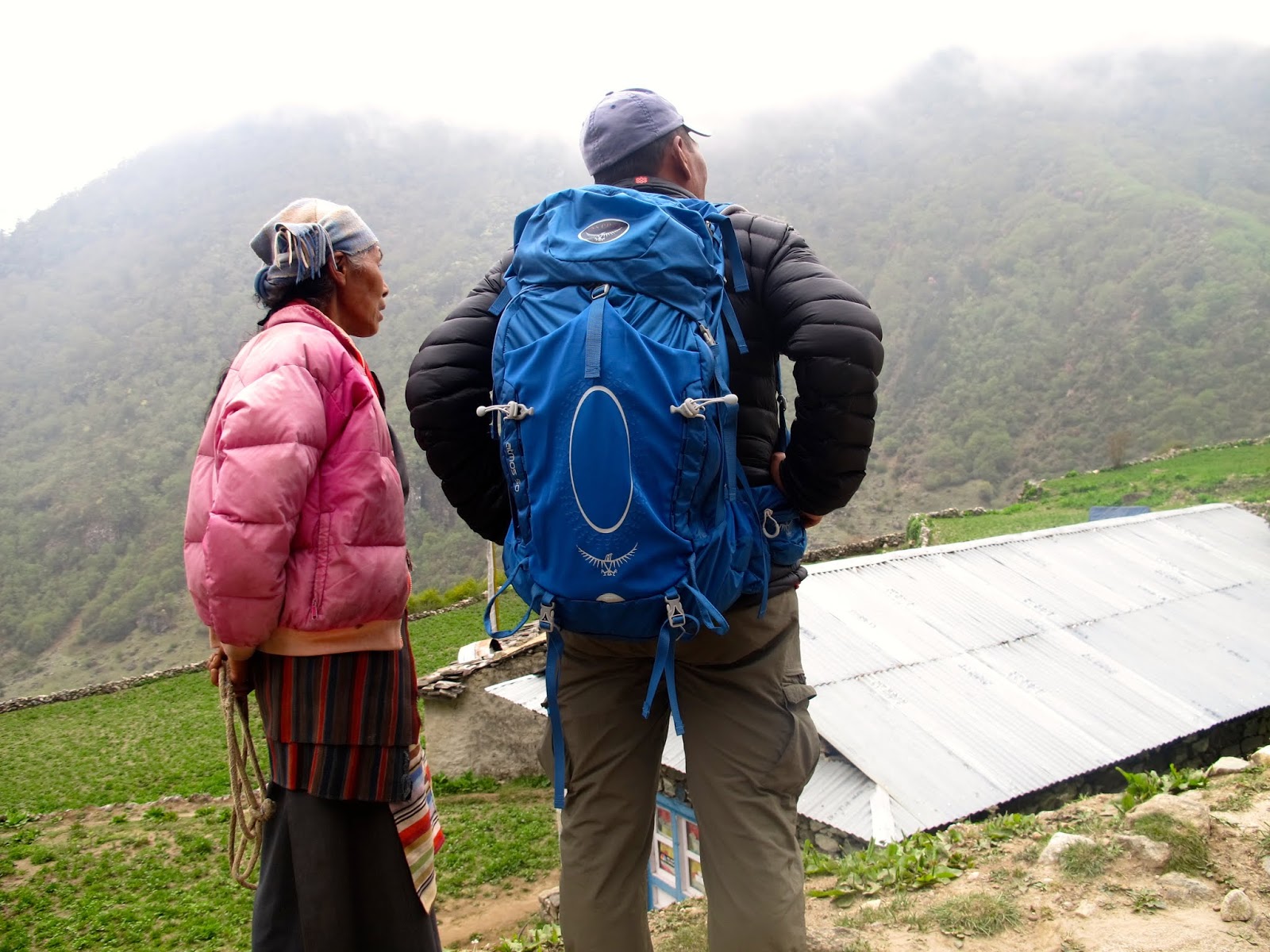
On the dusty path into Thame we came across an elderly grey-haired woman standing motionless on the side of the road wearing traditional local dress accessorized by a filthy faded pink North Face jacket. Flowing between her fingers were dirt-encrusted and well-worn Buddhist prayer beads, also known as a mala. She looked blankly down the path, her face deep-set with wrinkles, a stream of tears rolling down her cheeks as she murmured mantras under her breath. I was drawn to her tired, tear filled eyes. 

Dorje approached her quietly whilst I stood back and looked on trying to be respectful of their exchange. They spoke in hushed tones for a few minutes and then Dorje motioned for me to join them as we started down the dirt path in the direction of a large pile of rubble. 


Sadly and alarmingly, the large pile of rubble turned out to be the remains of her home. An old man appeared. He was limping and his tattered clothes were also covered in dirt. He greeted Dorje and I with sad, tired eyes and clearly needed medical attention. My Nepali doesn’t extend much beyond “Namaste’, and I couldn’t understand a word of the conversation however the gist was clear. 

Dorje translated the subtleties of the scene.  The elderly couple’s home had been completely destroyed by the earthquake. The woman had been making lunch over an open fire at the time. In the chaotic aftermath of the quake, all remaining and salvageable possessions that the couple owned had been engulfed and completely destroyed by the fire. Everything they owned had been lost. 

My heart churned. I didn’t know how to react. They were too old and fragile to rebuild their home.  The heavy rains of the monsoon season were fast approaching. As Dorje explained the story I looked at the ground whilst my feet shifted awkwardly in the dust. 

The couple and Dorje exchanged a few more words and we were invited to crawl on our hands and knees in the dirt under a warren of bright blue and orange tarps which served as a temporary shelter. It was damp, cold and smoky. Despite her age and fragility, the woman was surprisingly agile and her eyes seemed to brighten at the prospect of having us as guests in her home. I sat silently on the ground as she and Dorje continued to speak whilst her husband looked quietly on. An emanciated cat roamed in and sat down at my feet, meowed and looking up at me quizzically. I'd never felt so foreign in my life yet so much like I was exactly where I was meant to be. 

Water boiled in a rusty old pot.

The woman poured me a cup of steaming black tea, topping it up with a generous spoonful of sugar. She humbly offered me the scalding tin mug with both hands, a kind, warm and strong smile on her weathered face. I accepted the tea and drank it quietly. She then turned, dug into an old plastic crate and pulled out an unopened pack of biscuits. The pack looked shiny and strange and almost cheerful with its bright yellow packaging juxtapositioned against the somber scene under the tarp. 

Despite my protests she opened the packaging, looked me directly in the eye, reached out her hand and in perfect English offered, “Biscuit?”

I was certain that was one of the very few English words that she knew. I also knew that declining the ration of biscuit would have caused offense. Her eyes lit up with pride as I accepted her offering.

Dorje and the elderly couple continued to speak whilst I sat and drank bottomless cups of tea. They say that being ‘fully present’ allows you to connect with an experience and ‘feel’ it on many levels. I was overwhelmed by the energy in that small enclosed space under the bright orange tarp. It’s a feeling so intense that I can still feel it today, nearly 4 years on and I’ve gone back to that moment time and time again in the years since. I was filled with an incredible sense of purpose. I knew that the lesson of humility and kindness displayed by that couple in selflessly offering me everything they had would be a lesson that would stay with me for life.

Later that morning, the couple joined us as we continued the short walk up to Thame village where we met with the local people for the carefully organized distribution of relief.  As the elderly man marked his thumb to ‘sign’ for the receipt of funds (a total of $66 per person) he looked up at me and smiled. I knew that in a very tiny way I’d made his life a little bit better and maybe even a little bit easier. 

But I know in my heart that the impression that he and so many others I met that day left so much more on me. 


In 2017 I returned to Thame to visit the couple, bringing my own biscuits and see how they were doing. I knocked on the door to a small two story ‘home’ built of stones and old plywood. I saw a face appear from the second floor window and the familiar smile. As the door opened we were greeted warmly and with pride, and invited into the home for tea. we made a small offering of butter and juniper on the family alter in the corner of the room.

Smiles and gestures have the power to communicate so much more than words and actions can transcend language barriers. Seeing that the elderly man was ok and that he and his wife had resiliently rebuilt their lives filled me with a tremendous sense of calm. 

Before I left, I asked for a ‘selfie’. When I shared the end-result he looked at the photo in awe and wonder. His eyes filling with tears.... 

He looked at me, smiled and said, ‘So old!’.


I’ll never forget that day and I look forward to returning to Thame in a few weeks time.

In travel, so much inspiration is found through the stories of the people we meet along the way. A great reminder to breathe, truly live in the moment and take the time to enjoy the journey - because sometimes it is journey that IS the destination.... 


Feb 4, 2019

The People You Meet: "Where are you 'at'?

A friend recently reached out and asked where I was ‘at’. His use of quotation marks meant he wasn’t looking to hear that I was at Starbucks ordering a double-shot latte. The question made me pause, self-check and think - the reaction which met the questions intended purpose. Where was I ‘at’, really?

The question was timely and insightful. I’d slowly fallen into a cycle of chasing opportunities and experiences without much thought. "Fear of missing out" (aka FOMO) driven by an egoistic desire to ‘live life to its fullest because life is short’. Cliché. 

A potentially toxic alchemy of ambiguity stoked by social media, mid-life ‘crisis’, rejection, redirection and an incessant fear of not achieving my ‘so-called potential’. Somewhat ironically, in worrying about ‘not achieving my potential’, I was straying further from my potential - and further from my sense of “purpose” as a result.

What mountain are you climbing?


There are literally thousands of quotes about ‘purpose’ – I know this because I’ve spent more hours than I care to admit reading Instagram "inspirational quote" posts looking for answers that I already have. My favourite comes courtesy of Friedrich Nietzsche:

He who has a ‘why’ to live for can bear almost any,‘how’”. 

Essentially, be brave enough to live the life you want to live, according to your vision and your purpose instead of the expectations and opinions of others.  A simple quote yet hard to execute in practice… Hence why the, “I’m at Starbucks,” response to the well-intentioned question would’ve been an easier answer.

When I was in my late 20s and 30s I invested a lot of time ‘chasing summits’, both real and proverbial. I cringe when I write that.  Don’t get me wrong – it was a LOT of fun. I saw incredible parts of the world, experienced unique moments, developed deep friendships, and achieved some pretty big goals both in my career and in climbing mountains across the Himalayas, Andes and Alps. During this time I spent my time managing a fine line between a supportive corporate employer and cold hypoxic basecamps. Plus a lot of hard work and grit in between. And it was 100% worth it – all the conscious choices, decisions and investments. 

At the time, mountain summits were my purpose.  And I did well in working incredibly hard to maintain a steady focus in pursuing them, even knocking off a few big ones along the way… 

But did this truly fulfil me and feed a deeper desire to do ‘something more’…?  Well, honestly, no, not really.


I first discovered climbing in 2008 as the result of a break-up. Let’s be brutally honest – I got dumped. I escaped to the Himalayas to ‘heal’ and I joined a small expedition to climb Mera Peak, a 6300m “trekking peak” in the Everest region. I knew very little about mountaineering, had little experience, and was woefully unprepared. 

Three challenging weeks later our team reached the summit and I looked over a panorama of Himalayan giants framed against a cloudless blue sky. It was absolutely breathtaking. I knew that despite everything that I’d gone through to get there (it definitely hadn’t been easy), that there was no place on Earth I’d rather be. The boyfriend was forgotten and a new ‘passion’ for seeing the world from a different perspective had taken hold.  And off I went… 

This passion fed my ‘ego’ for a while - something I really needed at the time.  I aligned with an inspiring tribe of people that ‘understood’ my drive and helped me achieve my career and summit-goals. This included a number of kind and patient guides who became life-mentors and coaches as much as they were mountain guides. The insights and lessons that I learned from them and from my experiences helped build self-awareness, courage, confidence, and develop discipline and inner strength to see through barriers and overcome challenge. Mountains were the vehicle and the people I met along the way were the enablers to help unlock who I was, what ‘drove’ me, and most importantly what ‘fuelled’ my soul


Over twenty-five expeditions later climbing, trekking, biking and skiing in countries around the world I began to realise that what actually sparked me, what made my eyes light up and put ‘fire in my soul’ was so much more than mountain summits. The spark was so much more than ‘conquering’ trails, setting records, and looking for the ‘rah-rah-rah’ from a ‘like’ or a ‘retweet’… 

What truly sparked me and activated my energy was people. More specifically, sharing the journey in getting to some of these far-flung places (mentally and physically), the lessons learned along the way and, in some small way, prompting others to say ‘yes’ to stepping outside of their own metaphorical comfort zones. 

I came to this realisation very early in the pursuit of my climbing journey, but found myself downplaying it due to a strange inner drive to continue on my ‘summit-bagging path’ because it was the obvious, easier and more social-media friendly one. 

I began to deprioritise my authentic self and treated my true passion as a secondary by-product. I'm not sure I knew quite where I was 'at', at the time.

The day the earth moved…


After a while, I unsurprisingly found that feeding my ego through summits was no longer fulfilling or fuelling me. This was underlined during the 2015 Nepal earthquake, an event that shook me to my core.  

At the time of the earthquake, I was in Tibet, fully acclimatised and mid-way through an expedition to climb Shishapangma and Cho Oyu, two of the highest mountains in the world. My goal was to climb both mountains back-to-back in one season – this had only ever been done by one other woman. It was a big meaty challenge and one I’d worked and trained hard for. Lots of discipline, commitment, courage and creativity

I was passionate about the projects success. My journey was even being filmed as part of a short documentary and the small handful of social-media followers I had were being appropriately ‘spammed’ with updates on my progress. I’d been raising money for several incredible charities. I felt like I was doing the expedition for all the right reasons – checking all the boxes, so to speak. And on the surface I was – and it was all going to plan.  

The earthquake very quickly changed all that. Not only did it put an abrupt end to the expedition, it also prompted an immediate refocus mentally as well as physically. It challenged my purpose at its very core. 

In a way, it was karma’s way of saying, ‘where are you ‘at’?, and forcing an almost obvious answer.


Staying in Nepal following the earthquake was the easiest decision I’ve ever made. The calling was so intense that I can still feel it today, nearly 4 years on and haven’t felt anything like it since. 

I remember crying in my tent, still very much in shock from our experiences on the mountain. The tears weren’t because of what had physically happened on the mountain during the quake.  Rather, the tears flowed because I knew in my heart that I was absolutely terrified to stay in Nepal with all of the devastation, discomfort, unknowns and uncertainty. In the same breath, I knew without a shadow of doubt that I had to stay and that I was going to stay. Reconciling this fear with an overwhelming sense of purpose drew upon every bit of strength that I’d developed in my ‘mountaineering journey’, and using that strength to give back. To fulfill a calling that I simply could never have denied. So I stayed.

I became physically and emotionally involved in on-the-ground relief work both in Kathmandu and in the Khumbu region. I helped mobilise fundraising activities, working closely with several local and international charities. I learned firsthand about resilience, compassion, empathy, generosity, and kindness from some of the best teachers. I found incredible mentors who kindly took me under their wing and became like family.  

I felt I had a true purpose and that in embracing uncertainty, following my heart, and moving beyond a ‘fear of failure’ or following what I’d created as an artificial ‘pre-determined path’ had helped me to connect with what had truly fuelled me all along. And I don’t think that I’ve ever felt more secure or self-aware as a result – in an environment that could not have been more chaotic. During this time, mountains summits were never far from my thoughts but they no longer defined me or what I was truly capable of. 


When passion and purpose collide...

The earthquake never stopped me from climbing. It did however prompt a refocus and recalibration. Since 2015 I’ve continued to follow my passion for the mountains, climbing in Nepal and more recently in Canada and Alaska. But my focus and sense of ‘purpose’ has definitely become more defined and I no longer get the same ‘buzz’ off of a summit goal. The summit is for the ego. 

What I’ve learned is deeper and purpose-driven, from the ‘soul’ and from the heart. I now know that I climb for the people and the journey – sharing the experiences with others, and subsequently prodding, instigating and enabling others to ‘unlock’ their own stories and fulfil their own dreams - whether in a mountaineering environment or in life more broadly. 

Sometimes this is tactical – e.g. “How do you use a jumar? What’s the best down jacket? What’s the best training for an 8000’er.”  And sometimes, it’s about motivating people to realise their own journeys by prompting them to ‘check in,’ and understand what is truly stopping them from achieving their dreams. “What’s stopping you from going to Base Camp? Why don’t you ask for the time off? The worst your boss can say is, ‘no’, and removing self-doubt “Of course you can do it!” 

I’m grateful to organisations like Arc’teryx who have provided regular platforms to do this and supported me in sharing this narrative.  And I’m incredibly proud of those who use these forums as inspiration and prompts to, ‘say yes’. You know who you are!


So where am I ‘at’?

Like clockwork for the past 10 years, I find myself “at” the same place. That is, looking ahead to the pre-monsoon Himalayan climbing season asking myself “What am I going to climb this year… and why?” Whilst the more tactical aspects of Spring climbing plans are at the forefront of my mind, I continue to hold tight to aligning purpose and passion. 

In a world so heavily influenced by social media it’s easy to become distracted and portray an image that isn’t me or present a diluted version of what drives me or what my values are. Hence why my friends’ check-in was so well timed and gratefully received. 

I have a few exciting projects underway (my fingers tingle with energy as I type!).  Projects that have been developing in my mind for a while and that have engaged the imaginations and support of an incredible community of friends. 


So much of life is about leaning into the unknown. It’s about growth - moving toward people and moments you can’t predict the outcome of... A delicate balancing act of finding comfort in discomfort in a world that’s dynamic and constantly changing. It’s about adapting and making choices - some clear, some a bit foggier - that encourage us to move closer to the truth of who we are. This is something that I’m learning as I get older - and arguably wiser! 

I’m learning to trust in this truth. Owning it. Living it and breathing it. I’m not going to lie, it still feels like struggle to understand who I am and what I want but I have to remind myself that I’m forging a new path. Regularly asking myself, “what s ‘serving’ me and the world? What puts fire in my soul?” I’m learning that if something doesn’t feel right, to move on. I’m learning to follow my heart and my instincts. More often than not, they’re right…   

Thanks to prompts like, ‘Where are you “at”’, I’m learning to “check in.”  My inner compass is a measure. I have so much gratitude for an amazing tribe of people who help me to do this – because sometimes that inner compass needs a tiny bit of tweaking and recalibration.

When was the last time you checked in with yourself or with a friend and asked where you’re ‘at’? 

A small but simple gesture.

There are many days when I wonder what I’m doing and why - but then I stop, take a deep breath and pause. And I feel the growth and I'm excited where the adventure will lead….


Thanks for reading... xx