Jun 10, 2015
NEPAL EARTHQUAKE: When International Headlines Disappear
The seismic shifts have subsided, the number of deaths and
casualties have plateaued, and international headlines have all but
disappeared.... Sadly, the aftermath of the earthquake and over 300 aftershocks as
felt by over ¼ of Nepal’s population of 28-million remains a startling reality.
The new challenges are both violent and silent and will ultimately affect most
vulnerable populations including 1.7 million children, newborns and an
estimated 160,000 pregnant women in the affected areas.
Leaving the hustle and bustle of Kathmandu on the 31st
of May I looked out the taxi window and began a long journey of starting to
work my way through a complex set of emotions. Orange and blue tarps still
scattered like patchwork along the streets; mothers crawling out of their tents
with crying hungry children in their wake, men sweeping the dusty streets in
the early morning light. How lucky (?) I was to be able to just ‘leave’ and
return to the UK when so many millions of people have no choice but to face a
harsh reality.
For many people each new tectonic twitch heightens the
instability and uncertainty. Just last week a 4.4-magnitude tremor shook parts
of Kathmandu, sending the birds screeching into the air and the children
screaming into the cover of their tarpaulin camps. It was yet another
unnecessary reminder of what had happened – and what may yet lie ahead.
There's also the ‘invisible’ silent aftermath - the
earthquake’s impact on mental health. Mental health experts say those most
vulnerable to developing prolonged mental health conditions are children, the
disabled, and the elderly. Sadly, many of these people don’t have access to
councillors or professionals to help cope with mental stress and grief. There
are countless stories of men, women and children who become paralysed with fear
at the sound of loud noises, become overwhelmed by crowds, fear enclosed
places, and have a constant ‘earthquake hangover’ – the feeling that the ground
is perpetually moving, a temporary inner-ear reaction to the earthquake and
constant aftershocks.
In the departures lounge at the airport I saw another
national headline highlighting an issue that stopped me in my tracks – the trafficking
of women and children. Tens of thousands of young women from regions devastated
by the earthquake in Nepal are being targeted by human traffickers supplying a
network of brothels across south Asia. Many children are being picked up and
taken abroad by traffickers posing as relief workers. Many ‘tent cities’ are
now guarded by police offers stopping any children accompanied by an adult.
Over the past few weeks I feel as though I’ve seen humanity at its best –
people stepping in, risking their lives, helping those in need… but then I see
headlines like this. How can some people be so heartless?
I think it’s a feeling of helplessness and trying to balance
between getting back into my original, usual ‘work-life routine’ and
integrating the experiences of the past 2 months whilst ensuring that, like the
international headlines, my efforts don’t taper off and disappear. I guess this
is part of defining my ‘new normal’. All the while my Facebook newsfeed remains
full of stories and images of friends on the ground in Nepal building temporary
shelters like the earthbag homes, distributing tents and tarps, building
schools, distributing food and medical supplies and preparing for the monsoon
rains. It’s hard to be here because I
know how valuable an extra set of hands can be there. Having said that, I also know how many more funds are
required and how much continued awareness is needed to support these efforts to
help the vulnerable prepare for an uncertain future – their ‘new normal’.
Beyond continued fundraising efforts organised from the UK
and Canada, I plan to return to Nepal in the Autumn to continue to help with
the rebuilding efforts. Next Spring I will return and continue my expedition on
Shishapangma and Cho Oyu. They’re small contributions – mere drops in the ocean – to helping solve the wider problems but do make a difference. As the saying goes, I believe it was Mother Theresa who said it, whatever you can
give, no matter how small will be of great benefit. We ourselves feel that what
we are doing is just a drop in the ocean. But the ocean would be less because of
that missing drop.
-----
Thank you for your continued contributions and donations to the Paldorje Education Foundation - Nepal Earthquake Relief Fund. Whilst the Nepal earthquake headlines may no longer dominate the front pages of international media, the impacts here remain real and omni present. Please continue to donate, to spread the word and give what you can.
Jun 1, 2015
The Nepali Times Article: When The Mountain Moved
Lhakpa Wongchu Sherpa and I set out
from Shishapangma Advanced Base Camp on 25 April in heavy snow, limited
visibility, and a gentle breeze that left the long string of prayer flags
blowing gently in the wind. Despite the weather, we felt warm and safe in the
mountains as we began to make our way up to Depot Camp at 5800m.
It was a long, slow plod over a maze of rock, mud and snow
with limited opportunity to appreciate the mighty mountain vistas hidden in the
mist. We’d only been teased with fleeting views of this 8025m summit, the 14th
highest in the world.
I had been planning this ‘Himalayan Double Header’
expedition for six months: climb Shishapangma from early April to mid-May and
then travel overland to climb the 6th highest mountain in the world, Cho Oyu
for a mid-late May summit. If successful I would be the first woman in 23 years
to have done so and the 2nd woman ever.
When we reached the Depot Camp, I sat reflecting on my
passion for mountaineering. Mountains provide context, they are humbling and
make you realise there are forces in nature that will never be harnessed, that
won't bend to our schedules. Rather, we bend to theirs. Coming from a
consulting job that demands structure and planning, I find this lack of
‘control’ in mountaineering an opportunity for reckless mental and physical
creativity liberating.
I was tired but content. I took a sip of water and looked
down at my watch. 11.55am. My ears picked up a faint, deep rumbling sound that
broke the silence and sparked an almost animal-like instinct. Something wasn't
right. The rumbling continued, louder and louder.
My initial instinct was that this was an avalanche, but
where was it coming from? We were literally surrounded by mountains on all
sides and had zero visibility. The ground then began to shift back and forth in
a slow rhythmic movement. Earthquake.
Lhakpa shouted over the roaring sound of falling rock and
ice. Through the mist we tried desperately to establish the direction from
which the avalanche would come. We huddled next to a rock, our eyes darting in
all directions, hugging each other, terrified, praying that the rumbling and
shaking would stop.
In what felt like an eternity, the seismic shifts beneath
our feet finally subsided. As we fearfully made our way back to Advanced Base
Camp, we noticed the impact of the quake and the avalanches of snow and rock it
had released. There were fresh cracks in the ground, loose boulders dislodged,
cracked ice in the lakes. Almost eerily, the snow stopped and the cloud lifted,
and rather than a scene of destruction and devastation, the mountain vista stretched
out before us seemed almost beautiful, natural and strangely rebalanced.
Back in Advanced Base Camp we learned that the earthquake
had been widespread but were limited to the details by an almost complete lack
of communications. It wasn’t until our evacuation from the mountain and arrival
back in Kathmandu on 5 May that I began to realise the full scale of the
disaster. I’d only heard about the tragedy on Everest but hadn’t prepared
myself for the bigger picture. It was overwhelming, at a scale unprecedented to
my senses and any previous frames of reference.
My first day back in Kathmandu was an emotional roller
coaster walking through the rubble and dust of the once familiar streets and
past ancient monuments. Concerned for my wellbeing, family and friends demanded
I return home. But going home would mean turning my back on a country that had
been so incredibly generous to me since my first visit 15 years ago. I knew I
had skills that would be helpful in mobilising the aid required to provide
relief and support the rebuilding of the country. I decided to stay and help my
friend Tashi Sherpa of Sherpa Adventure Gear and his team raise funds for
earthquake relief through the Sherpa Adventure Gear Paldorje Education
Foundation and provide assistance with the distribution of aid to those most in
need.
On 12 May I was in Kathmandu assisting with this relief work
when the second earthquake struck with a magnitude 7.3. Being on a mountain for
the first earthquake and in a city for the second was equally terrifying. This
time the danger wasn’t avalanches coming down, it was the buildings.
On the ground relief work has opened my eyes to the scale of
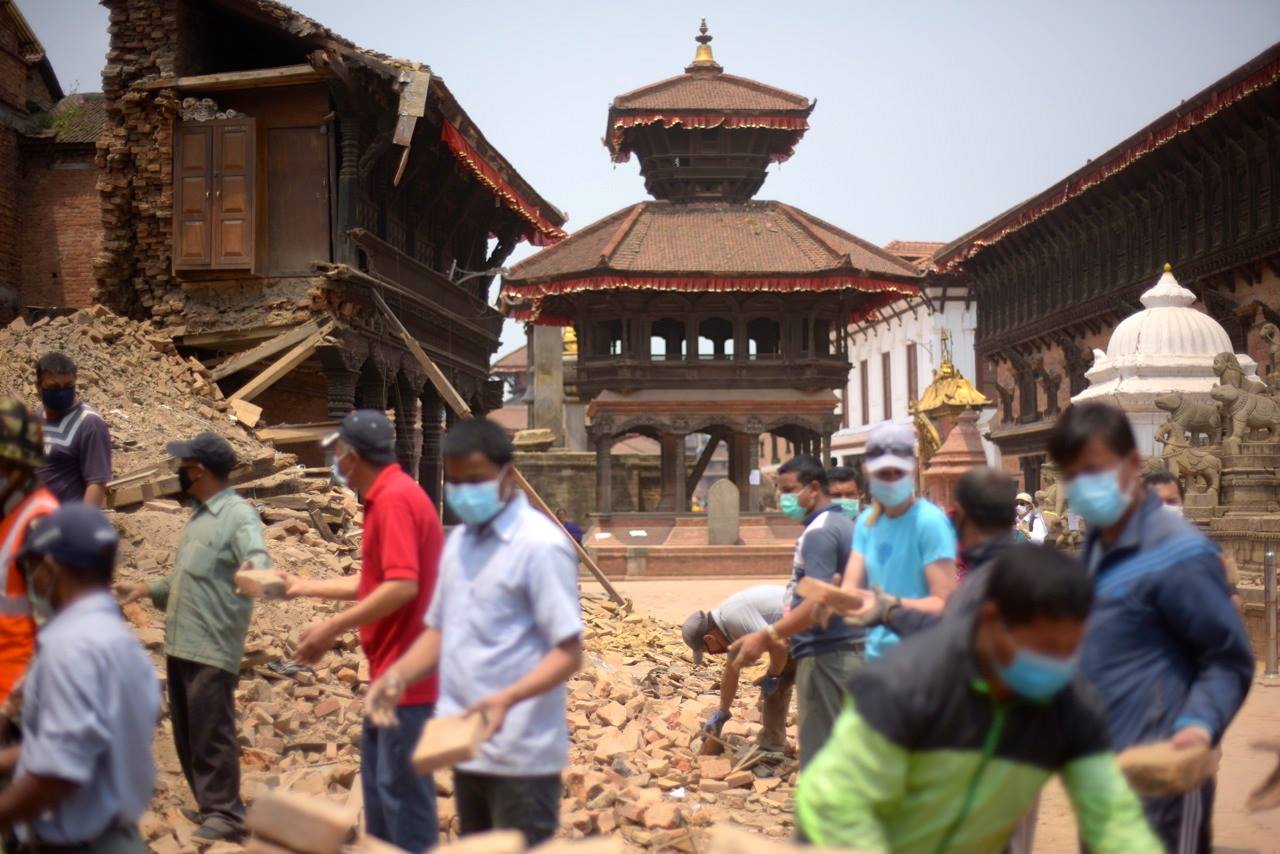
the disaster: many villages still look like a war zone. Buildings tilt at
vertiginous angles, a door or window visible through a twisted mess of
corrugated iron. Brown dust drifts over the disintegrated remains of once proud
homes.
I’ve since travelled and distributed relief to areas that I
didn’t even know existed, unpronounceable place names on a map are now
personified by images of rubble and the outstretched arms of the vulnerable.
This week, we distributed relief to a community in Dolakha. Last week I
travelled to the Khumbu to deliver financial aid to 234 families in Thame, and
delivered aid to survivors of the Langtang tragedy now living at the Yellow
Gompa in Kathmandu. Over the past month we’ve distributed over a thousand tents
and tarps, thousands of kg of food, and provided extensive financial support.
I’ve seen more of the country and met more incredibly inspiring, resilient
people than I’ve ever thought possible.
Amid the long, deep cracks and between the rubble, I’ve also
found something to be positive about for the longer-term future of the country.
This is the initiative and energy of Nepal’s youth which is rapidly gaining
momentum: a groundswell which will bring greater and longer-lasting change than
the devastating earthquakes.
Sometimes I forget that I originally came to Nepal in early
April to climb mountains. Little did I know that when I arrived that these
mountains would be more proverbial than real. The people that I've met, the
things I've seen and the lessons learned have been more impactful than any
summit I've ever attempted, stood on or dreamed about.
May 30, 2015
NEPAL EARTHQUAKE: Sometimes I forget that I came to Nepal in April to climb mountains.
Sometimes I forget that I came to Nepal in early April to climb mountains.
At 11.55am on April 25th, 2015 I was on the snow-covered slopes of Mt. Shishapangma, the 14th highest mountain in the world, when a magnitude 7.8 earthquake struck.
The weather conditions that morning offered zero visibility so when the earth began to move and the ice, rock, and snow tumbled down with a vengeance we were left paralysed with fear and confusion. Completely disoriented by our surroundings my Sherpa guide Lhakpa and I didn’t know where to run for safety – we were literally surrounded on all sides by mountains. It was like we had 4 loaded guns pointed at us as we tried to guess which would ‘shoot first’. Fortunately none did. I can say with a strong degree of confidence that it was the most terrifying few minutes of my life.
On May 12th I was in Kathmandu assisting with relief work when the second earthquake struck. I escaped unscathed but sadly, in old and poorly constructed buildings around the across the city and around the country, many lost their lives.
The contrasting experiences of being on a mountain for the first earthquake and in a city for the second have been equally terrifying. In the city it wasn’t avalanches coming down that frightened me, it was Kathmandu’s old rickety buildings.
Still today, 1-month on, I feel a perpetual ‘earthquake hangover’ and jump at the slightest ‘bumps,’ both real and imagined - apparently a common inner ear reaction to the aftershocks - some 260 since April 25th. On more than one occasion I’ve gripped the table, frantically seeking confirmation, ‘Did you feel that?’
Perspective…
I’ve been asked by many people how I feel about what happened… Am I sad not to have continued with my expedition? What I have I learned from my experiences over the past two months? How have I made an unfortunate situation a positive one? What have I learned through the relief work that I’ve been involved in?
I could write a book about everything that I’ve felt, seen and heard. To keep it simple I’ve found three simple words which best sum it up – Resilience. Resourcefulness. Respect.
Resilience
The past two months have taught me about resilience.
It wasn’t until our evacuation from Shishapangma and arrival back in Kathmandu that I began to realise the full scale of the disaster – something we’d been protected from in our lofty Himalayan heights. I’d only heard about the tragedy on Everest but hadn’t prepared myself for the bigger picture. It was overwhelming, at a scale unprecedented to my senses and any previous frames of reference. The earthquake’s devastating impact had killed over 8600 people, injured over 18,000 and left hundreds of thousands homeless and sleeping under flimsy tarps in the streets.
One month on and many of the villages I’ve visited still have the look of a war zone. Buildings tilt at vertiginous angles, a door or window visible through a twisted mess of corrugated iron. Brown dust drifts over the disintegrated remains of once proud homes.
But between the rubble and cracks in the walls, hope shines through. I’ve been astounded by the resilience with which Nepalis have been tackling the most adverse of conditions in not only a stoic, but also a heroic, manner. This applies not only to the villagers in the most-affected districts, but the waves of Nepalis selflessly volunteering to help themselves and their fellow citizens in this time of national need. As swathes of the country have become a patchwork landscape of tents, Nepalis stand resiliently strong.
I can’t help but think back to an elderly woman we met in Thamo, just outside of Namche Bazar in the Everest region. She was praying on the trail on our way into the village – her face weather beaten, her eyes tired but strong. She led us to what was left of her home where she had been making lunch when the earthquake struck. She had run out of the house as the building crumbled to its foundations around her.
As if that wasn’t enough, the pile of rubble caught on fire and the fire consumed all that was left.
When we visited, all that remained what a blackened, charred heap of rocks. Beside it, two simple bright orange tarps that had been converted into a tent, a dented kettle, a mud-stained and charred duvet, a blackned photo of a religious figure and an emancipated and sickly looking cat.
We were invited into her tarped ‘home’ where we met her elderly husband who was praying in front of a small alter set up against a pile of rocks. The woman offered me a cup of hot milky tea – I knew how scarce resources must have been for the couple and how proud she was to still be able to offer me a drink. I felt humbled. A package of dry biscuits then appeared… I think that ‘tea’ and ‘biscuit’ were among the only two English words she spoke.
The couple never asked for money, they never complained, they only told their story and spoke of their plans in an uncertain future. They would take what they had and rebuild, slowly but surely, brick by brick.
We offered them a meagre contribution of financial relief which they accepted with tears streaming down their cheeks. I don’t think I’ll ever forget the looks of quiet gratitude on their faces.
Resourcefulness
The past two months have taught me about resourcefulness.
I could list numerous examples of resourcefulness. From the grassroots movements of Nepali and international volunteers who travel to far-flung villages to distribute food to the individuals and communities who worked together to provide emotional and physical support during the grim and difficult task of searching the rubble for survivors to the ongoing staffing of 24-hour medical posts operated by local and international volunteers... ‘Community Kitchens’ have been established in the tent cities whilst relief-and-rebuilding initiatives, school rebuilding projects are all underway.
Many of these initiatives started within hours of the first earthquake and are ongoing to this day.
Since my return I’ve been fortunate enough to stay with my friends, Tashi and his wife Tseten Sherpa at Sherpa Adventure Gear, a global outdoor clothing company headquartered in Kathmandu and with retail outlets around the world. Tashi is CEO. The company’s logo is the ‘the Endless Knot’ – meaning, ‘What goes around, comes around.’ The auspicious symbol represents the unity of thought and action, words and deeds, wisdom and compassion.
Within 24 hours of the first earthquake Tashi and Tseten had assembled a team of volunteers (employees who themselves had been directly impacted by the earthquake) who worked around the clock using the sewing machines and fabrics once reserved for waterproof and fleece jackets and jumpers to produce and distribute hundreds of blankets, tents and tarps to those most in need.
Despite international and local business pressures, clothing production and distribution deadlines were put on hold as the factory became a recognised as a leading example of relief coordination and activity.
Through the Paldorje Education Fund, an existing Sherpa Adventure Gear fund providing scholarships to underprivileged children, Tashi immediately established an Earthquake Relief Fund – which has raised nearly $150,000. The money, from generous donors around the world, has provided relief in the form of tents, tarps, medical supplies, food, and financial assistance to hundreds of families most in need.
The resourcefulness of the company, its selfless leadership and the compassion shown to the people of Nepal has become an example for others – and has provided a personal example to me, demonstrating a resourcefulness that I’ll remember long after these tectonic tremors have subsided...
Respect
The past two months have taught me about respect for the environment.
I majored in Geography in university. I knew that nature could be as ruthless and powerful as it was beautiful. Through mountaineering I've seen the beauty firsthand. Through mountaineering I've now also seen and felt the other extreme. Never in my life have I felt as humbled by nature as when the ground began to rumble below my feet on April 25th. I was convinced that the avalanches rolling down the face of Shishapangma would be my end. Subsequently, I’ve continued to feel completely helpless with each of the aftershocks – their unpredictability, their randomness, their silent, omnipresent threat.
In the village of Langtang, one of Nepal’s most popular trekking destinations, moments after the earthquake struck a massive expanse of ice fell thousands of feet, creating an avalanche that obliterated a community where 400 people lived and where nearly 100 foreign trekkers are believed to have been. In a matter of seconds the entire village was wiped off of the face of the earth, buried under 50 – 80 feet of rock, snow and ice. Only 180 villagers survived and many of the trekkers lost their lives. Landslides triggered by subsequent aftershocks continue to make the area unstable and unsafe and the search for bodies have had to be put on hold. Nature's ruthless force.
Last week, here in Kathmandu, the ‘pre-curser’ to the monsoon rains began. It was only 3pm but the sky was completely black. As the sky began to rumble from above, the unsettled earth began to rumble from below. Once again I felt incredibly helpless and truly put in my place unsure where to go to ‘hide’ from the powerful forces that nature was once again about to unleash up on us. It came in the form of gale-force winds, claps of thunder, flashes of lightning, hail, and torrential rain.
But then in contrast to the chaos I can’t help but think back to those early weeks of April on Shishapangma. As Lhakpa and I fearfully made our way back to Advanced Base Camp, we couldn’t help but notice the impact of the quake and the avalanches of snow and rock it had released - fresh cracks in the ground, loose boulders dislodged, cracked ice in the lakes. Almost eerily, the snow had stopped and the cloud had lifted, burnt off by a blazing Himalayan sun. Visibility was restored and rather than reveal a scene of destruction and devastation, the mountain vista stretched out before us seemed almost… beautiful, natural and strangely rebalanced.
As quickly nature destroys, it also brings peace and reveals beauty.
Closing thoughts…
Sometimes I forget that I originally came to Nepal in early April to climb mountains. Little did I know that when I arrived that these mountains would be more proverbial than real. As I prepare to head back to the UK tomorrow, I can’t help but reflect that the people that I've met, the things I've seen and the lessons learned have been more impactful than any summit I've ever attempted, stood on or dreamed about. And for those lessons I’ll be forever grateful.
At 11.55am on April 25th, 2015 I was on the snow-covered slopes of Mt. Shishapangma, the 14th highest mountain in the world, when a magnitude 7.8 earthquake struck.
The weather conditions that morning offered zero visibility so when the earth began to move and the ice, rock, and snow tumbled down with a vengeance we were left paralysed with fear and confusion. Completely disoriented by our surroundings my Sherpa guide Lhakpa and I didn’t know where to run for safety – we were literally surrounded on all sides by mountains. It was like we had 4 loaded guns pointed at us as we tried to guess which would ‘shoot first’. Fortunately none did. I can say with a strong degree of confidence that it was the most terrifying few minutes of my life.
On May 12th I was in Kathmandu assisting with relief work when the second earthquake struck. I escaped unscathed but sadly, in old and poorly constructed buildings around the across the city and around the country, many lost their lives.
The contrasting experiences of being on a mountain for the first earthquake and in a city for the second have been equally terrifying. In the city it wasn’t avalanches coming down that frightened me, it was Kathmandu’s old rickety buildings.
Still today, 1-month on, I feel a perpetual ‘earthquake hangover’ and jump at the slightest ‘bumps,’ both real and imagined - apparently a common inner ear reaction to the aftershocks - some 260 since April 25th. On more than one occasion I’ve gripped the table, frantically seeking confirmation, ‘Did you feel that?’Perspective…
I’ve been asked by many people how I feel about what happened… Am I sad not to have continued with my expedition? What I have I learned from my experiences over the past two months? How have I made an unfortunate situation a positive one? What have I learned through the relief work that I’ve been involved in?
I could write a book about everything that I’ve felt, seen and heard. To keep it simple I’ve found three simple words which best sum it up – Resilience. Resourcefulness. Respect.
Resilience
The past two months have taught me about resilience.
It wasn’t until our evacuation from Shishapangma and arrival back in Kathmandu that I began to realise the full scale of the disaster – something we’d been protected from in our lofty Himalayan heights. I’d only heard about the tragedy on Everest but hadn’t prepared myself for the bigger picture. It was overwhelming, at a scale unprecedented to my senses and any previous frames of reference. The earthquake’s devastating impact had killed over 8600 people, injured over 18,000 and left hundreds of thousands homeless and sleeping under flimsy tarps in the streets.
One month on and many of the villages I’ve visited still have the look of a war zone. Buildings tilt at vertiginous angles, a door or window visible through a twisted mess of corrugated iron. Brown dust drifts over the disintegrated remains of once proud homes.
But between the rubble and cracks in the walls, hope shines through. I’ve been astounded by the resilience with which Nepalis have been tackling the most adverse of conditions in not only a stoic, but also a heroic, manner. This applies not only to the villagers in the most-affected districts, but the waves of Nepalis selflessly volunteering to help themselves and their fellow citizens in this time of national need. As swathes of the country have become a patchwork landscape of tents, Nepalis stand resiliently strong.
I can’t help but think back to an elderly woman we met in Thamo, just outside of Namche Bazar in the Everest region. She was praying on the trail on our way into the village – her face weather beaten, her eyes tired but strong. She led us to what was left of her home where she had been making lunch when the earthquake struck. She had run out of the house as the building crumbled to its foundations around her.
As if that wasn’t enough, the pile of rubble caught on fire and the fire consumed all that was left.
When we visited, all that remained what a blackened, charred heap of rocks. Beside it, two simple bright orange tarps that had been converted into a tent, a dented kettle, a mud-stained and charred duvet, a blackned photo of a religious figure and an emancipated and sickly looking cat.
We were invited into her tarped ‘home’ where we met her elderly husband who was praying in front of a small alter set up against a pile of rocks. The woman offered me a cup of hot milky tea – I knew how scarce resources must have been for the couple and how proud she was to still be able to offer me a drink. I felt humbled. A package of dry biscuits then appeared… I think that ‘tea’ and ‘biscuit’ were among the only two English words she spoke.
The couple never asked for money, they never complained, they only told their story and spoke of their plans in an uncertain future. They would take what they had and rebuild, slowly but surely, brick by brick.
We offered them a meagre contribution of financial relief which they accepted with tears streaming down their cheeks. I don’t think I’ll ever forget the looks of quiet gratitude on their faces.
Resourcefulness
The past two months have taught me about resourcefulness.
I could list numerous examples of resourcefulness. From the grassroots movements of Nepali and international volunteers who travel to far-flung villages to distribute food to the individuals and communities who worked together to provide emotional and physical support during the grim and difficult task of searching the rubble for survivors to the ongoing staffing of 24-hour medical posts operated by local and international volunteers... ‘Community Kitchens’ have been established in the tent cities whilst relief-and-rebuilding initiatives, school rebuilding projects are all underway.Many of these initiatives started within hours of the first earthquake and are ongoing to this day.
Since my return I’ve been fortunate enough to stay with my friends, Tashi and his wife Tseten Sherpa at Sherpa Adventure Gear, a global outdoor clothing company headquartered in Kathmandu and with retail outlets around the world. Tashi is CEO. The company’s logo is the ‘the Endless Knot’ – meaning, ‘What goes around, comes around.’ The auspicious symbol represents the unity of thought and action, words and deeds, wisdom and compassion.
Within 24 hours of the first earthquake Tashi and Tseten had assembled a team of volunteers (employees who themselves had been directly impacted by the earthquake) who worked around the clock using the sewing machines and fabrics once reserved for waterproof and fleece jackets and jumpers to produce and distribute hundreds of blankets, tents and tarps to those most in need. Despite international and local business pressures, clothing production and distribution deadlines were put on hold as the factory became a recognised as a leading example of relief coordination and activity.
Through the Paldorje Education Fund, an existing Sherpa Adventure Gear fund providing scholarships to underprivileged children, Tashi immediately established an Earthquake Relief Fund – which has raised nearly $150,000. The money, from generous donors around the world, has provided relief in the form of tents, tarps, medical supplies, food, and financial assistance to hundreds of families most in need.
The resourcefulness of the company, its selfless leadership and the compassion shown to the people of Nepal has become an example for others – and has provided a personal example to me, demonstrating a resourcefulness that I’ll remember long after these tectonic tremors have subsided...
Respect
The past two months have taught me about respect for the environment.
I majored in Geography in university. I knew that nature could be as ruthless and powerful as it was beautiful. Through mountaineering I've seen the beauty firsthand. Through mountaineering I've now also seen and felt the other extreme. Never in my life have I felt as humbled by nature as when the ground began to rumble below my feet on April 25th. I was convinced that the avalanches rolling down the face of Shishapangma would be my end. Subsequently, I’ve continued to feel completely helpless with each of the aftershocks – their unpredictability, their randomness, their silent, omnipresent threat.
In the village of Langtang, one of Nepal’s most popular trekking destinations, moments after the earthquake struck a massive expanse of ice fell thousands of feet, creating an avalanche that obliterated a community where 400 people lived and where nearly 100 foreign trekkers are believed to have been. In a matter of seconds the entire village was wiped off of the face of the earth, buried under 50 – 80 feet of rock, snow and ice. Only 180 villagers survived and many of the trekkers lost their lives. Landslides triggered by subsequent aftershocks continue to make the area unstable and unsafe and the search for bodies have had to be put on hold. Nature's ruthless force.
But then in contrast to the chaos I can’t help but think back to those early weeks of April on Shishapangma. As Lhakpa and I fearfully made our way back to Advanced Base Camp, we couldn’t help but notice the impact of the quake and the avalanches of snow and rock it had released - fresh cracks in the ground, loose boulders dislodged, cracked ice in the lakes. Almost eerily, the snow had stopped and the cloud had lifted, burnt off by a blazing Himalayan sun. Visibility was restored and rather than reveal a scene of destruction and devastation, the mountain vista stretched out before us seemed almost… beautiful, natural and strangely rebalanced.
As quickly nature destroys, it also brings peace and reveals beauty.
Closing thoughts…
Sometimes I forget that I originally came to Nepal in early April to climb mountains. Little did I know that when I arrived that these mountains would be more proverbial than real. As I prepare to head back to the UK tomorrow, I can’t help but reflect that the people that I've met, the things I've seen and the lessons learned have been more impactful than any summit I've ever attempted, stood on or dreamed about. And for those lessons I’ll be forever grateful.
May 27, 2015
NEPAL EARTHQUAKE: The life and times of a bag of food relief...
To help our Nepal earthquake relief fund supporters see the tremendous impact of their donations, I would love to one day attach a video recorder onto a bag of relief
goods that passes through our doors here at the Sherpa Adventure Gear HQ in
downtown Kathmandu. I'd love to visually record the journey as the relief follows the 'supply chain' and makes its way out of our distribution centres, onto the trucks and into outstretched arms of those most in need.
As our Sherpa Adventure Gear Earthquake Relief Funds’ commitment is to ensure
that 100% of all of the donations we receive from across the globe
are delivered directly to the individuals and families most in need we are always immediately involved in the process.
Yesterday I again had the opportunity to experience this
firsthand as I travelled overland with our team of volunteers from Sherpa Adventure Gear in a heavily loaded truck to deliver and help distribute relief to a community in Dolakha. Dolakha is one
of the districts worst affected by the 25 April earthquake and the epicentre of
the 7.3 aftershock on 12 May. In Dolakha, 134 people have been killed and 304 people
injured since 25 April and thousands have been left homeless – now living under
plastic tarps and sharing rickety stables with what livestock remains.
Aftershocks continue to rock Dolakha – even yesterday as we distributed the relief the ground continued with gentle seismic shifts below our feet.
Bringing dhal to Dolakha
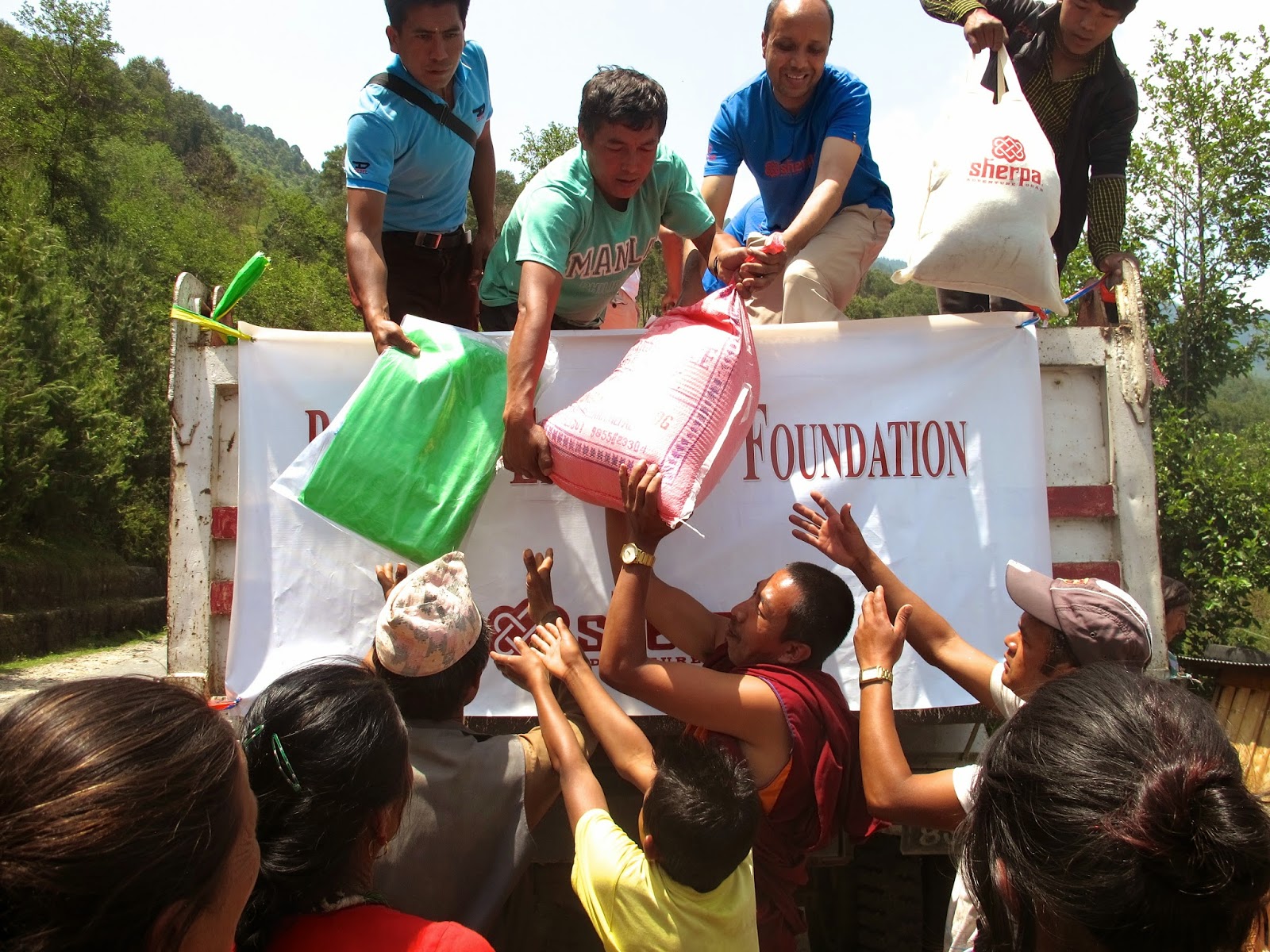
As an intrepid team of 5, our mission was to distribute 100 tarps, 100 x 30kgs bags of
rice, 100 x 10 kgs of beans, 100 x 10kgs of dhal, cooking oil, water filters,
water purification tablets, and biscuits. These were
personally delivered to the individuals and families as selected by their communities
based on the degree of loss suffered during the earthquake - many having lost both their homes and family members. These relief goods had all been donated or purchased locally here in Nepal through the generous contributions of people from across the globe to
our Nepal-based earthquake relief fund. All those involved in the entire process are volunteers.
We loaded the truck in the early hours of 6am and turned into the bustling Kathmandu traffic – the temperature was already above 25 degrees – it was going
to be another scorcher of a day. The early signs of monsoon are starting to reveal themselves with a fury – hot days and in the evening, heavy rains and high winds.
We’d experienced a horrific
wind and rainstorm the previous evening. Kathmandu’s populous tent cities had clearly
borne the brunt of last nights storm as people emerged from the battered remains
of their ‘shelters’ with soaking blankets, screaming children, soggy clothing
and grim faces. It had been a long night. And the monsoon season technically hasn’t even
started… this is just a precursor and a warning of devastation that is to come. As many have predicted, we have not even begun to see the true
impact of the Nepal Earthquakes yet.
Sindupalchok and Dolakha
Our 4 hour journey took us through one of the hardest hit
districts of the earthquake – Sindhupalchok. In this district alone, 4,242
people were killed, 4,000 injured, and 95% of homes destroyed.
One month after the disaster, many of the communities still
have the look of a war zone. Buildings listed at vertiginous angles, the
occasional door or window visible through a twisted mess of corrugated iron.
Red dust blowing through the wind drifting the disintegrated remains of bricks
which had once made up proud homes. High up on what must have been the second
floor of one house, a kitchen cupboard clings to an external wall, tins and
packets of food still sitting on its shelves… an emancipated cow roams the
street.
In one of the villages we passed a hospital where over 200 people
died in their beds when the buildings supporting walls crumbled and the building literally collapsed on top
of them. A blind man in a lonely wheelchair sits, as if abandoned, next to a spaghetti-like mess of iron bars which once supported the concrete structure.
Communities are suffering – as much physically as
psychologically. With every tectonic tremor people are sent screaming to the
perceived shelter of their tents. But now the bigger danger isn’t just earthquakes,
it’s also landslides. With the coming monsoon rains, the number of landslides
is expected to increase exponentially as many mountain slopes have become
unstable and ready to release with devastating consequences to the communities,
agriculture, livestock and the country’s extensive network of river systems.
2-3 weeks of food... and hope
It ‘looks’ all doom and gloom from the surface but there are
many layers to a tragedy.
Arriving at our pre-arranged meeting point in Dolakha, we
were met by a group of about 150 locals, made up of a lively collection men,
women and children. They greeted our
convoy of food with weary looks of happiness – in most cases, likely thinking
ahead to the first warm, full meal they may have had in days. The children
smiled shyly with toothless grins, hiding behind the long colourful bright
pink, green and blue dresses of their mothers and sisters. The elderly looking
on quietly, their eyes tired yet resilient, their weather-beaten faces bearing
witness to the arduousness of living off the land and season-to-season
unpredictability of nature. The men proud with strong, kind faces, speaking
quietly amongst each other reviewing how the organised distribution taking
place.
One woman in the community held a pre-agreed list of names
of people who would receive their donation. As she called out the names, the
locals would come up one by one and handed their heavy loads. Even the elderly
hoisted the 30kg bags of rice on their shoulders as if they weighed no more
than a few kilos each. Whilst this was happening the children played together
and were given packages of biscuits that they shared amongst each other and
devoured with joy.
The entire distribution took about 1.5 hours and will
provide 100 families with enough food for at least 2 - 3 weeks. The tarps will
provide temporary relief from the rains while the remains of homes are slowly
recovered from the rubble and reconstructed. Water purification systems will
limit the spread of disease and reduce instances of diarrhoea.
As I watched three spritely old women walk up a
boulder-strewn path back to the remains of their home I couldn’t help but think
of the less tangible but equally important impacts of our distribution that day. This aid, provided
thanks to the generous contributions of people from all over the world - will
give these 100 people in the community of Dolokha renewed strength and hope…
two things they’ll need in spades as they begin to rebuild their lives out of
the rubble and plan for a future ahead.
On behalf of everyone here in Nepal, THANK YOU SO MUCH for your continued contributions and donations. Whilst the Nepal earthquake headlines may no longer dominate the front pages of international media, the impacts here remain real and omni present. Please continue to donate, to spread the word and give what you can.