May 25, 2015

NEPAL EARTHQUAKE Report: The Khumbu - Open for business... almost

The Khumbu, often referred to as ‘The Gateway to Everest’, sees a large portion of Nepal’s 600,000 visitors per year. With an extensive network of well-maintained stone and dirt trails meandering through friendly towns, past idyllic guest-houses, local farms, and waving children shouting ‘Namaste’, the Khumbu captures both the heart and the imagination.  For many, the first visit to the Khumbu will inevitably lead to more.

This week, in the aftermath of the magnitude 7.8 earthquake and subsequent aftershocks which devastated Nepal, I had the opportunity to travel to the Khumbu. The purpose of my visit to the region was three-fold: (1) to hand-deliver much needed earthquake relief in the form of financial support and shelter to the village of Thame in the Khumbu on behalf of the Sherpa Adventure Gear Nepal Earthquake Relief fund (2) to assess the damage to the area between Lukla and Thame (3) to get a break from Kathmandu where I felt like I was suffering from an ‘earthquake hangover’ – the constant feeling the ground was moving even when it wasn't…apparently an inner ear reaction to all the aftershocks, some 240 since April 25th

The Journey:
On May 18th I flew into Lukla, an infamous and remote mountain airport bearing the unenviable reputation of being ‘the most dangerous airport in the world’. Having just survived 2 earthquakes I pushed my luck even further, flying in what seemed like my own fully stocked private jet packed with with tents, tarps and medical supplies provided by aid agencies around the world.  

I’ve traveled the flight between Kathmandu and Lukla on a number of occasions but what made the journey unique this time were the startling views  –  a patchwork of orange, yellow and blue tarps scattered across the rolling hills and between the rubble remains of destroyed homes and villages littered across the countryside.

The earthquake came during Nepal’s popular spring trekking season. I’d expected the region to be quieter than usual given the circumstances but I was shocked to find that literally every trekker, mountaineer and tourist (as well as many locals) had left… All that remained were myself and two well travelled Americans – Mike and Parker – who were on a mission to deliver relief to Khumjung and assess the damage to the Khumbu Climbing School in Phortse. They were welcome company on the quiet and sometimes treacherous, landslide prone trails. With a backgrounds in carpentry and climbing and past trips through the area their insights proved to be equally informative. 

To provide some context, when we entered Sagamartha National Park, paid our $38 and passed through the checkpoint we were told that there had been 5 tourists in 5 days… including the three of us. Normally at this time of the year (April - May) between 3,000 - 5,000 trekkers pass through the park gates.

CONTEXT:

I’ve done my best to summarise below some of my observations about the well-trodden route between Lukla and Thame. Before going into detail I stress that these insights are based on my visit between 18 – 22 May 2015 only and are compared to my last visit to the area in the Spring of 2013. 

Given the speed at which the area is already being rebuilt, I fully expect that any specific photos or accounts of damaged or destroyed homes and landslide-prone trails will be out of date by the autumn trekking season. 

The ‘executive summary’ is that Khumbu will once again be open for business and ready to welcome trekkers to the region come Autumn. The caveat to this statement is that the region will, in the short - medium term,  be heavily reliant on both financial support to help with ongoing rebuilding efforts and continued tourism dollars coming into the region.

Main villages visited:
18 May: Lukla (2880m) – Phakding (2610m) – Monjo (2804m) (overnight)
19 May: Jorsalle – Namche (3445m) 
20 May: Namche (3445m) - Thame ( 3820m) – Namche (3445m)
21 May: Namche (3445m) – Lukla (2880m)
22 May: Lukla - Kathmandu

OBSERVATIONS:

Building Damage:

Lukla
Beyond cracks and minor structural damage to many of the older buildings, Lukla sustained only minor damage with popular haunts such as the ‘Lukla Starbucks’ still serving up steaming hot lattes and mouth watering carrot cake. Popular lodges including Paradise Lodge remain open and fully operational with the kitchen continuing to serve up the best momos on this side of the country. The most significant damage that I saw was a completely destroyed and burned-out building mid-way through town formerly known as ‘The Sherpa Café’ – this may have been damaged before the earthquake.  

Whilst building damage appeared minimal the psychological impact of the earthquake is significantly higher. A large portion of the population of Lukla (and the Solukhumbu and Khumbu more broadly) have moved to temporary shelters including tents, tarps and wooden animal stables. Living in fear of future earthquakes, many locals feel that their homes are unsafe and sleep outside and under rather than return to their homes – some of which could be made structurally safe with minor repairs.

Lukla - Phakding
Between Lukla and Phakding we saw a considerable amount (circ 70%) of buildings with structural damage varying from minor cracks, missing sections of wall to the complete destruction of the structure. 

A number of buildings at the top of the path leading down to Jiri appeared to have been completely destroyed with the taller buildings along the trail now tilting at vertiginous and improbable angles and balancing precariously on the steep slopes. Around them, the hills of rubble reveal the occasional door, window and sheet of twisted corrugated tin. High up on what must have been the second floor of one guesthouse, a kitchen cupboard clings to an external wall, tins and packets of food still sitting on its shelves, a flower pot balancing precariously in a glassless window…

We stopped for a delicious lunch at the Sunrise Lodge in Phakding.  Like many of the guesthouses and lodges Phakding, the Sunrise Lodge appears to have suffered a fair amount of structural damage – particularly to its older stone-contructed sleeping quarters. These will have to be rebuilt. The newer sleeping quarters made of a combination of stone, wood and mortar appear to have sustained only minor damage. 

On a positive note – perhaps reflective of the future of the Khumbu and the resilience of its people – between 18 and 21 May the stone walls around Sunrise lodge which had been completely knocked over had been completely rebuilt. If this is indicative of the speed of rebuilding then there’s no doubt the area will be able to sustain tourists for the Autumn season. 

An ongoing theme was the ‘clean up’ which had already started in earnest. Resourceful Nepali’s had ensured that any salvageable lumber / tin / stone in buildings which had been levelled to their foundations had already been stacked into neat, organised piles, ready to be reused. 

As a recommendation (and I suspect that this is already being addressed), there would be tremendous value in stepping up ongoing efforts to provide locals with research / training on how to build more ‘earthquake resistant' homes using a combination of available materials including the increasingly popular ‘soil bags’ along with timber, stone and mortar so that past mistakes are not repeated – or can at the very least be minimised.

Phakding - Monjo
From Phakding to Monjo the scale of devastation appeared to increase with about 75% of the buildings having significant structural damage and held up by struts. There were greater numbers of lodges and cafes impacted. 

If the primary building material was stone then damage was often significant and the building was now uninhabitable. If mortar was used in conjunction with the stone then there was often little to no damage – and in some cases the home appeared to be habitable with only minor repairs / reinforcement required. 

Many buildings supported by timber foundations (including wooden posts) and a wooden structures appeared to be in near perfect condition. We guessed that this was in part due to a combination of the soil-structure of the ground under the house and the ‘flex’ nature of the wood in response to the earthquake. 


Monjo

We slept in tents (along with most of Monjo and Jorsalle) on the front lawn of the 'Monjo Guest House'. From its exterior, the main building of the guesthouse appeared to have survived unscathed.  A quick look inside revealed that all was not as it seemed - literally all the interior walls and a large part of the roof had caved in. The entire building is unsafe and will have to be rebuilt. The glass and timber built dining room suffered little to no structural damage. 

Work had already begun on a temporary tin shelter next to what used to be the main sleeping quarters. 

As Monjo has been without electricity since the first earthquake, we dined by candlelight with the locals and enjoyed a delicious dahl baht feast.

Monjo – Namche
Jorsalle, just outside of Monjo suffered significant damage with about 80% of the buildings suffering major cracks, missing parts of walls and/or held up by long wooden struts. Significant rebuilding work will have to take place before most buildings in Jorsalle are habitable again.

Namche
Buildings in Namche seemed to have suffered only minor damage in comparison to the rest of the Solukhumbu and Khumbu that we’d passed through. 

Perhaps one of the hardest hit buildings by the earthquake is the guesthouse of popular and rather iconic Café Daphne – the site of many a post-climb celebration. Whilst the main bar area and internet café remains intact (albeit with a very wobbly wooden floor), the old stone-built sleeping quarters have been completely destroyed. Efforts are already underway to rebuild and have as much of the building open and safe for tourists coming through in the Autumn.

The Shree Himalayan Primary School in Namche is completely destroyed – the scale of the destruction shocking with many of the exterior and interior walls having completely caved in. There were about 145 pupils attending the school, from the age of three-and-a-half up till 11 years of age and coming from all parts of the Khumbu.

It’s hard to find a ‘silver lining’ on the situation but if there is one it is that it’s incredibly fortunate that the initial earthquake struck on a Saturday – the only day that children don’t attend school - and that the equally devastating second earthquake occurred while the children all been on their lunch breaks.

I stayed at the Hotel Sherwi Khangba, located a few minutes walk above Namche Bazar and also the home to the popular Sherpa Culture Museum. The hotel was fully operational with no visible damage and sustaining a fully operational kitchen. Only the traditional entrance gate to the hotel and its significant stupa suffered structural damage as did some of the walls around the museum. I did not visit the museum on this occasion so am unable to provide an update on its current state.

The front lawn of the Hotel Sherwi Khangba has become Namche’s ‘tent city’ housing about 70 tents ranging from large multi-family Red Cross tents to expedition-style sleeping tents and providing temporary shelter to about 200 people.

Namche – Thame
The entire valley of Thame and its neighboring Thameteng was devastated by the initial earthquake including complete destruction of the Thame monastery, one of the oldest in the Khumbu. Any buildings that ‘survived’ the first earthquake were subsequently destroyed in the aftershocks. A total of 423 houses were damaged affecting the population of 1876 people.

We visited one elderly couple in Thamo, a ‘suburb’ of Thame. Their home had been completely destroyed. Any remaining and salvageable possessions that they’d owned had been destroyed in a fire which subsequently engulfed the rubble. 

Offering countless cups of tea, the kind and weather-beaten couple never said it directly but the worries were clear in their eyes – how would they ever begin to rebuild their home

Trail infrastructure:
Overall the trails were in good condition with only a few areas between Lukla and Phakding covered by some minor localised rock-fall that has likely already been moved. 

Whilst the trail was free from objective hazards, we continued to be vigilant for rockfall and landslides and would advise others traveling through the region in the foreseeable future to do the same.

There significant evidence of active landslides between Phakding and Monjo with a ½ km section of the trail just after Phakding directly impacted. In this section two large landslides have made the main trail inaccessible and dangerous for sections varying from between 2 – 25 meters and remains an active and ongoing hazard. The ground in this section is very unstable with large cracks appearing directly on the ground and threatening to slide between 30 -  40 metres down the cliff.  We were able to climb up and around the landslide prone-areas but with extreme caution.

The bridges appeared unaffected by the earthquakes. It was great to see both the ‘high bridge’ and the ‘low bridge’ accessible and in use just below the long hot slog that is the infamous ‘Namche Hill’.

Water:
Streams in the area were flowing rapidly. Most of the water stand-pipes are made of plastic, they remain functional, providing clean safe water. The extensive aquaduct system around Monjo remained intact.

At the time of visiting the bigger water-related concern was the status of Imja Lake and the ongoing threat that it poses on downstream communities. The lake is considered by researchers to be among the three most dangerous glacial lakes in Nepal.  The recent earthquakes are rumoured to have affected the moraine of the lake however at the time of visiting I found no evidence to support this.

Agriculture:
The main agricultural food staples in the area are potato, wheat, maize and millet. There did appear to be some activity in the terraced fields and plots of land around the villages where farmers could be seen actively weeding around the maize crop and many potato fields. Based on our general observations there does not appear to be an immediate / short-term food shortage and agriculture has not been badly affected by the earthquakes.

Tourism:
Tourism to the area has been severely impacted. 

When we passed through the checkpoint entrance to Sagamartha National Park we were told that we were the 5th trekkers to pass through the gates in 5 days. Not a promising figure for a region which, in April 2014, welcomed 7,208 trekkers and in May, 1,392 trekkers – (these figures do not reflect expeditions which would add another 1,500 to those numbers). In total the Khumbu welcomes through its park entrance over 35,200 trekkers per year. The lack of revenue generated by trekking permits and park entrance fees will certainly be felt.

Resourcefulness and Resilience:
Walking up on 18 May, several small villages between Lukla and Monjo appeared to be completely empty – with the panes of glass removed from many of the lodge windows and the curtains left blowing silently in the breeze.  It was eerily quiet for an area that always seems to be full of activity. We learned the following day that this may have been due to ongoing  (and false) ‘predictions’ about further earthquakes.

It’s worth noting that on my descent back down to Lukla just a short 3 days later on 21 May, the general atmosphere of the area was completely different. There was a flurry of rebuilding activity taking place with men, women and children active in the streets, in their homes and in the fields – structures being torn down whilst others were being rebuilt. A number of lodges back open for business and shops with soft drinks and chocolate bars on display in store windows. Where villages were devoid of children playing in the streets, they were now alive and abuzz with activity... It was starting to look like 'business as usual' again.

Whereas we didn’t see any porters while walking up to Namche on the 18th, I passed about 45 porters walking up between Lukla – Namche on the 21st  while I was walking down. All were heavily loaded with timber, sheets of corrugated tin, building supplies as well as rice, lentils, eggs and other food staples.

In short, it appears that slowly but surely the daily hubbub of life is returning to the Khumbu.

The future…
After a disaster of such magnitude, the task of reconstruction will never be easy – especially for an area inaccessible by motor transport and where all supplies have to be walked up or flown in. 

Having said that, as seen so clearly in the Khumbu, the rebuilding work has begun – and in light of the impending monsoon, this is all the more critical with thousands of people living under tarps, in tents and in temporary camps. Full recovery will take both time and patience – the Nepali people must continue to be resourceful and resilient.

And all the while the Nepali people and the thousands of tourists that will continue to visit this beautiful country must remember that the ground will stop shaking, the dust will settle, and we will live on to build a new Nepal. 

------------


Much gratitude and many thanks for reading, and for caring. Whilst the devastating Nepal Earthquake headlines may have disappeared from the front pages of the international media, the country  and its people still need your help to rebuild.  Please consider making a donation to:


May 17, 2015

NEPAL EARTHQUAKE Editorial: "Nepal's Youth - Shaken…. And Stirred"

I first came to Kathmandu in back in 1999. Fresh out of university, ready to explore the country’s rolling hills and snow-capped mountains with not more than a few dollars in my pocket. Beyond the endearing smiles and warm ‘Namastes’ that drew me to the country, I fell in love with the city’s postcard-perfect ancient architecture, towering pagodas, palatial walls, rabbit-warren of narrow streets and alleys, dusty roads, and chaotic traffic. 

Everything that I found endearing about Kathmandu on that first encounter and have continued to enjoy on every subsequent visit made it a dangerous place on April 25, the day a magnitude-7.8 earthquake struck Nepal, kicking off hundreds of aftershocks that continue to rock the country and the psyche of its people.

On that day beautiful old brick and wooden buildings crumbled to the ground in a cloud of ancient dust and rubble, bringing with them long-held ties to a deep-rooted past. The narrow streets once alive with the hubbub of market stalls, playing children and Saturday trading were turned into death-traps. Tents that once were used as trading centres for farmers now used as morgues, infirmaries, and make-shift hospitals. In the mountains tsunamis of snow, mud, rocks and rubble took out entire villages.

I was climbing an 8000m mountain called Shishapangma during the first earthquake and was lucky enough to have escaped unscathed. It wasn’t until I arrived in Kathmandu after our evacuation that I began to realise the full scale of the disaster – something we’d been protected from in our lofty Himalayan heights. We’d only heard about the tragedy on Everest but hadn’t prepared ourselves for the bigger picture.  It was overwhelming, at a scale that was unprecedented to my senses. It an emotional roller coaster walking through once familiar streets without being overcome with emotion for a nostalgic past.

I was in Kathmandu for the second earthquake of magnitude 7.4 which took place on 12 May. Again, I managed to escape unscathed along with the others in the building. Sadly, in old and poorly constructed buildings across the city and around the country, many lost their lives.  The contrasting experiences of being on a mountain for the first earthquake and then being in a city for the second one were equally terrifying.  To this day I feel a perpetual ‘seasickness’ and jump at the slightest ‘bump’ – both real and imagined. On more then one occasion I’ve gripped the table, frantically seeking confirmation, ‘did you feel that?’

Whilst the building that I have been staying in has remained intact, in other parts of Kathmandu, old homes crumbled, and those that remain standing are scarred by long, threatening cracks. Many families must now decide: Live in a dangerous home? Or sleep outside, under a leaky tarp and in fields that are slowly turning to mud? Stay in Kathmandu or move away from the city’s deathtrap and into the surrounding villages.

The deathtoll from both earthquakes and aftershocks is now over 8,000 and the numbers are expected to reach 10,000 at a minimum.

But I’m an eternal optimist - I’ve quickly learned that you have to be when working in a crisis zone. For every step forward there will be two steps back. I’m looking desperately to find the silver lining… and finally, amid those long, deep cracks and between the rubble a silver lining has started to appear.  And this has started to provide hope.

The silver lining appears in the form of the initiative and energy of Nepal’s youth which is growing and rapidly gaining momentum here in Nepal… a groundswell which will bring greater and longer-lasting change than the devastating earthquake of 25 April. This is the New Age of Nepal – and it is an age of change.

And change is so desperately needed in a country that has been stricken by a decade-long civil war, a constitution in turmoil, a suffering economy where 25% of the population lives below the poverty line and a government that is slow and unwilling to react... A government that brought wider roads and narrower viewpoints...

Politics, bureaucracy and more red-tape than if you strung all the prayer-flags in Nepal end to end have hampered the speed and effectiveness of government managed relief efforts. Much to the frustration of those who need it most and the thousands of volunteers who are delivering aid and providing medical support, there have been rumours of a backlog of relief-supplies piled up in the international airports cargo terminal.

When I decided to stay in Nepal and help with the relief efforts, I offered my support to the Sherpa Adventure Gear – Nepal Earthquake Relief Fund. The fund was set up by the global outdoor clothing brand, Sherpa Adventure Gear, with its headquarters and most of its productiontaking place in Nepal. 


Noting the number of people actively involved in the ground distribution of aid and support, I decided to focus my efforts on awareness and fundraising. This would help provide the necessary financial resources and supplies to empower trusted and locally chosen individuals and groups with established networks and local knowledge to personally deliver relief to the areas and individuals that needed it most… This approach not only empowers people at the local level in a transparent and accountable way but also ensures that that 100% of the money – every dollar, every pound, every rupee – is used to provide relief to the country, to revive its people, restore hope and to start the rebuilding process. It allows us to ‘spread’ our efforts further than the boundaries of the Kathmandu valley and reach out to those in the Khumbu, the Solu, Laprak, Ghorka, Charikot… the list goes on - villages that were once a dot on a map, now personified by tragic images and stories of the earthquake victims and the rubble that was once their homes. 

What I have since seen through the relief that we have funded through the Fund is that even in the grim aftermath of this disaster, hope shines through. A grass-roots movement is taking place among its young, connected and talented youth. Social media platforms including Twitter, Facebook, Instagram and apps including Whatsapp allow the youth to mobilise quickly both locally and at a global level to make their voices heard and effect change – reaching remote areas before international aid and government relief. For example, on Instagram, ‘The NepalPhotoProject’, was formed hours after the earthquake by a group of photographers on the ground in Nepal from India, Nepal and Bangladesh, among other countries, as a place to share images and information about the earthquake and its victims to allow relief to get to those areas quickly.  

As Sherpa Adventure CEO Tashi Sherpa describes, “…the youth are back to show the entrenched old guard how it should be done: entrepreneurship, a passion for social enterprise and a fearlessness to question the establishment.” (A new generation will help Nepal rise up and rebuild; Seattle Times,)


Since the earthquake the country has seen more and more new start-ups eagerly initiated, students with a ‘can-do’ resourcefulness inspired for social service and volunteer work in faraway villages – we allocated some tarps today for distribution by a group  of well organised and articulate students today from Solukhumbu. Professional investors with links to global markets becoming more common and voters pushing for government reforms. The subtext is a warning for those who are slow to and/or refuse to change. “Nepal’s spring of change is happening right now.” Change is slow until it’s not.

Before 25 April my most impactful memories of Nepal were dominated by snow-capped mountains and warm cups of tea in the comfort of high mountain camps. The past few weeks have changed the focus of these memories. People, hope, human acts of resilience – these are my new memories of the ‘New Nepal’ – and defined by cities as well as mountains.  And these are the memories of the actions which I believe are reflective of and will continue to shape the future of this magnificent country and its people.

With this groundswell of resilience, resourcefulness and hope, I am confident that this is just the beginning of the future. 

Nepal will rise.

-------

Please consider making a donation to the Sherpa Adventure Gear  - Nepal Earthquake Relief Fund: https://www.crowdrise.com/helpsherpashelpnepal


May 12, 2015

NEPAL EARTHQUAKE: Help us to help Nepal - Please donate to the Nepal Earthquake Relief Fund

When I was growing up there was a game that I was absolutely obsessed with – a simple game called ‘cats cradle’. The game involves one piece of string tied end-to-end and can be played between two or more people. It involves creating a series of string ‘patterns that get progressively more complicated with every ‘rotation’.

I hadn’t thought about cats cradle in quite literally years – until I entered a ‘pop up’ medical tent in historic city of Bhaktapur, an area just outside of Kathmandu which suffered extensive damage. Amongst the hundreds of patients seeking medical attention – everything from check ups to more extensive injuries – and the general chaos were a group of young girls playing cats cradle. They gave me a huge smile and I couldn’t help but stop and join them for a game – the piece of string being perhaps the only toy that could be salvaged from the rubble that was once their home.

Continuing on I couldn’t help but notice how another family had constructed simple shelter outside a dusty pile of bricks that was once their home – now in ruins and looking like it had been hit by a bomb. Their make-shift house is a bright orange tarp donated by one of the aid agencies. Under the tarp is a pregnant mother with a toddler running around in the dirt, a chicken waddles through the rubbish. Her husband killed in the earthquake. In the middle one thin mattress-less platform bed salvaged from the house. That and a dented kettle is everything she now owns in the world. The biggest fear is more aftershocks… 

That was the day that I decided not to return home but rather to stay in Kathmandu and do what I can to help the people of Nepal deal with the tragedy that has impacted over 80% of the population. Today the numbers rise to over 8,000 people dead, double that injured, thousands left homeless and even more buildings now uninhabitable. The headlines in the newspapers here make grim reading… If there was ever a time to ‘give back’ to a country that has been so incredibly good to me, it's now.

I read today that there have been hundreds of stillborn births and miscarriages – I can’t help but think of the pregnant woman and her toddler under the tarp… I’m saddened as I know that her case is like so many others – both here and in the country’s remote areas. 

Every day the situation changes – it’s a rollercoaster of emotion. One minute you feel like you’re making progress, you see an unexpected smile, you read a story of a family saved, a loved-one lost but then found, much needed relief efforts reaching a remote villages… and then the next minute a new challenge is thrown at the country and its people. Yesterday it was another landslide in Langtang – once a thriving tourist region, now a scene of destruction absolutely devastated by the earthquake with hundreds dead and a pile of rubble a 50-80metres deep in some places. Each day brings us closer to the monsoon and months of torrential rain – torrential rain that will bring with it flooding, landslides and disease. 

Today there was another earthquake. I, like so many others in the city, had finally stopped pausing every time we thought we'd felt the ground move or heard an unusual rumble.

A earthquake measuring 7.4 that not only ripped through the heart of the country - the Khumbu - but also violently jolted the moral of a people who had just begun to start life in the 'new normal' - amid the rubble and dust. A life where tents, poor sewage, and the disparity between the 'haves' and the 'have nots' becomes increasingly startling and apparent.... but sadly, and slowly, the new way of life.

People continue to ask what they can do to help – and these requests are tremendously appreciated and your help is so needed - even more so as the ‘headline hitting’ impacts of the earthquake become “yesterday’s news” for the international media. 

I believe the most effective way to help is to send money through the relief funds set up, so that this can be disbursed in the most transparent and practical ways to those that need it most.  I’ve been working with an incredible fund - Help Sherpas Help Nepal - that has been providing relief to people and communities in some of the most disparate parts of the country. Incredible, dedicated and selfless efforts from volunteers have brought much needed relief those who had given up hope. 

And hope - as well as continued resilience and resourcefulness -  is what the country and its people will need to survive. 

Depending on the aid agency, the funds go toward a myriad of things  - anywhere from feeding those desperate families in the remote hills who have received little to no support to those families here in Kathmandu lined up in the ‘tent cities’ begging for food and water to tending to those lined up outside the hospitals to buying tarps, tents, and longer term – bricks and mortar so that the rebuilding process can begin.  Every little bit helps. It’s so easy to make a difference here.

Nepal is a resilient nation. The country seems to ‘bounce back’ from one disaster after another – last years tragedy on Everest, the storms in the Annapurna region in the fall, the Turkish airlines disaster, and now an earthquake that has ripped through the heart of the country. 

The response from the international community has been overwhelming – but there is so much more to be done. It’s a sentiment that’s evident everywhere in Kathmandu. Everyone seems to be doing the only thing they can right now, which is trying to help in whatever way they can. The news reports are so desperate, the situation so dire. Aftershocks continue to rattle the country – setting off landslides, deepening the cracks in the homes or shaking them to the ground.

In the face of the ups and downs we must not lose hope and we must continue our efforts to recover and rebuild.  

Much gratitude and many thanks for reading, for caring – and I hope that you will consider making a contribution to the rebuilding of this country and its people. 

Your donations are needed now more than ever - please give what you can to help: https://www.crowdrise.com/helpsherpashelpnepal


Apr 25, 2015

NEPAL EARTHQUAKE: Shishapangma Seven Point Eight

Gasping for breath in the thin air I looked at my watch – 11.55am. An excellent time.  

Lhakpa Sherpa and I had set out from Shishapangma Advanced Base Camp (ABC) at 9am in mixed conditions – heavy snow, fog, little visibility, and a gentle breeze that left the long string of prayer flags blowing gently in the wind. It was one of those mornings that you could almost hear the individual snowflakes falling to the ground, quietly covering the earth in an ephemeral blanket of white. Despite the weather, we felt warm, safe and enclosed in the ‘sanctuary’ of the mountain as we began to make our way up to ‘Depot Camp’ at 5800m. The objective of the round-trip would be to establish a 'cache' of tents, gas, stoves and other supplies that we’d carry up the mountain to higher camps on future rotations. 

It was a long, quiet walk that left us each to our own thoughts as we plodded our way over a maze of rock, mud and snow – there was little opportunity to gaze out and fully appreciate the mighty mountain vistas hidden in the mist. I’d been mesmerised by the fleeting views of the mountain over the past 15 days as we’d been making our way to its snowy base and was happy to finally begin establishing the route which would take us to her 8025m summit, the 14th highest in the world.

A quiet sigh of relief escaped my lips when I saw the giant lump of rock marking our final stepping stone before moving onto the icy glaciated and crevassed terrain that would lead us to Camp 1. Exhausted, I flopped down on a rock and gazed into the curtain of mist, wondering what secrets the mountain would reveal. 

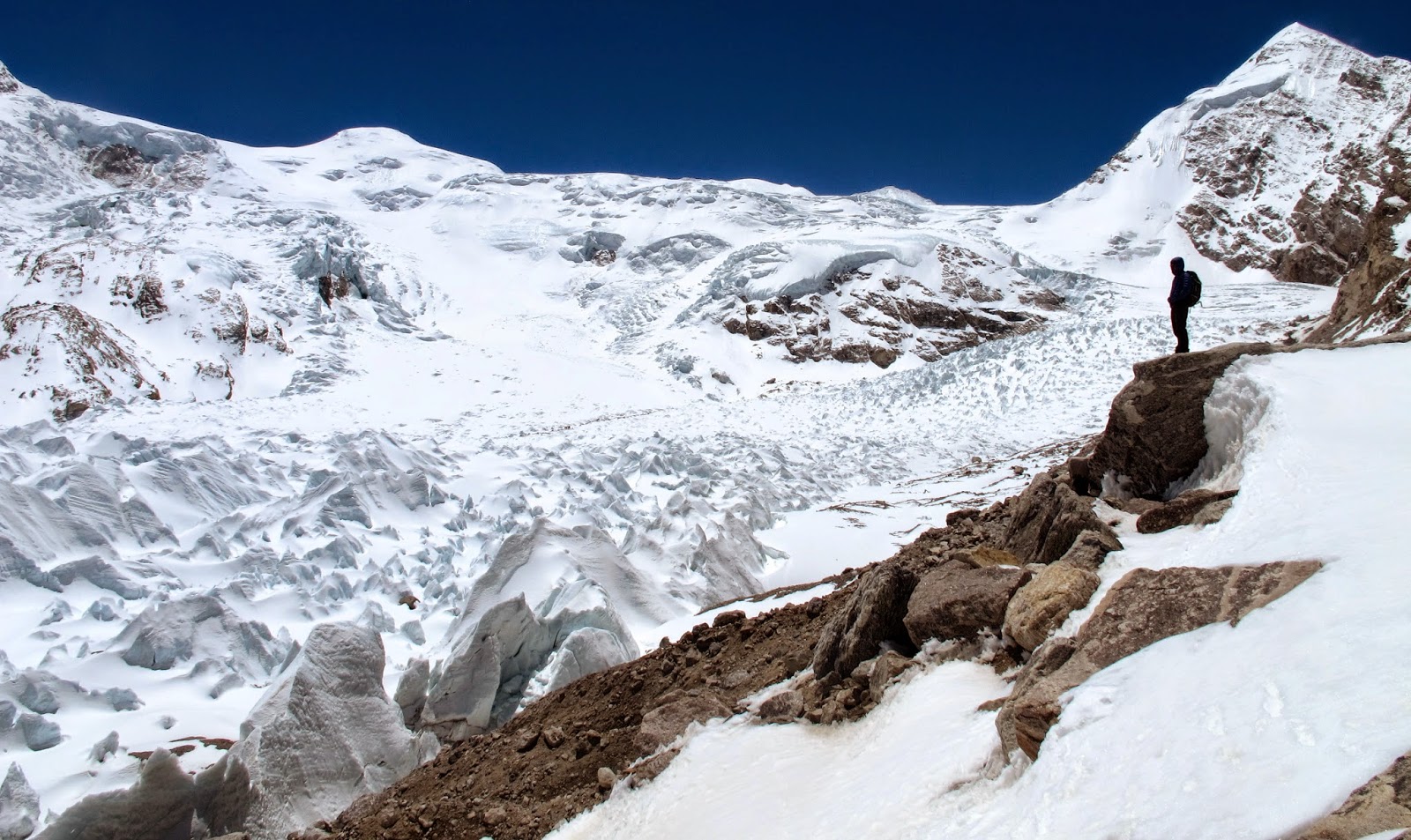
I tried to assess my surroundings through the conditions. I could make out a row of jagged snow spires, 'penetents' and guessed that behind them were the snow-loaded and rolling slopes of Shishapangma; slopes that I'd studied in photographs, slopes that had captivated my imagination over the past few weeks, slopes that I’d visualised hundreds of times in preparation for this expedition. To my right, a steep, exposed rocky face with a ramp of dirty boulders. Behind us, another series of tall white snow spires, reminding me of foot-soldiers, protectors of the secrets that the weather conditions had conspired to hide from us and separating us from the aggressive snow covered peaks of Langtang. Finally, to our left, the traces of our footsteps rapidly filling with snow. 

Sat there in silence I reflected on why that mornings walk had been so satisfying. Put simply, mountains provide context - they make you humble and give you the sense that there are forces in nature that will never be harnessed, that won't bend to our schedules. Rather we bend to them. Coming from a job that often demands organisation and structure,  I find this lack of ‘control’ and opportunity for reckless mental and physical creativity liberating.

I was tired but content to be in such humbling, powerful surroundings. It was eerily quiet. I took a sip of water and looked down at my watch. 11.57am.

My ears began to pick up a faint, deep rumbling sound. A natural sound that broke the silence and sparked an almost animal-like instinct. Something wasn't right. It sounded like a steam engine picking up speed, like one you’d see in an old country western movie. Lhakpa and I looked at each other quizzically.  

The rumbling continued, louder and louder. 

My initial instinct was ‘avalanche’ - but where was it coming from? We were literally surrounded on all sides by mountains and had zero visibility and the sound seemed to echo from all around. My eyes darted in all directions trying to assess where the danger was coming from. It was so confusing.

I then felt the ground begin to shift back and forth in a slow rhythmic movement… like jello. I looked down confused at my knees which began to bob up and down. I tried to stand up and turn around and stumbled sideways. 

Earthquake. 

In that split second, I was mentally transported back to university geography class mapping out plate tectonics… and in the next second I tried to recall what to do in the event of an earthquake - stand in a door frame sprang to mind – but where were the door frames?!

Lhakpa shouted over the rumbling. ‘Avalanche!’ followed by ‘Stay down’. We tried desperately to assess where the avalanche was going to hit us from as our eyes scanned in all directions and crouched to the shaking, rumbling ground. I began to gasp, ‘ohno ohno ohno ohno’… under my breath in an effort to stay calm. I felt like four loaded guns were all pointed at us and I wondered which was going to shoot first.

My main focus was trying to establish which direction the avalanche would come from as I knew we were surrounded on all sides by mountains.  Would we get hit by the avalanche itself or the debris. If I hid behind the giant rock, would the impact move the rock and crush us in the process?

 Staring out at the sea of white all around me I thought, "Is this ‘it’? Is this really ‘it’? Here? On Shishapangma?" I turned round in circles trying to get the bearings on where the danger lay.

Lhakpa shouted something over the roaring sound of falling rock against a background of rumbling. He was crouched next to a rock, eyes darting in all directions. I ran to him and we huddled together on the rock hugging each other, terrified, praying that the rumbling and shaking would stop and that the avalanche or avalanches would not hit us. 

I'm not sure how long the earthquake lasted - I don’t think that it was more than 20 – 25 seconds but it felt like an eternity. It’s amazing how many things can go through your mind in a few split seconds; it’s amazing how quickly ‘animal’ like instincts kick in. I’ve never been so afraid in my entire life. 

Even after the rumbling stopped we stayed hunched on the rock, our bodies attuned and senses heightened to every sound and movement. More rumbling followed, falling rock could be heard all around… but we knew we had survived the initial quake and any avalanches that had come down had missed us. We still had zero visibility and were relying purely on instinct. 

Lhakpa pulled out our radio to communicate back to Advanced Base Camp. Our hope was that because we had been on a glacier - generally quite ‘elastic’ – that the earthquake had felt much worse than it was. Perhaps those at Advanced Base Camp hadn’t even noticed it?

I looked at my watch – it was now 12.05. If the earthquake had been felt on Everest most climbers technically should have already passed through the icefall. My mind drifted back to my conversation with Lhakpa the previous evening. We’d spoken about about his brother on the South Side of Everest and his own personal experience in last years avalanche, prompting his decision to climb Shishapangma this year. My mind also drifted back to our conversation about his young family in Pangboche, a small mountain village just next to Everest itself. I wondered whether they too had felt the earthquake and prayed that they were ok.

Lhakpa and I sat on the rock at Depot Camp for a few more minutes before we began to make our way back.  Slowly and keeping together we left at 12.35pm. 

We began to notice the impact of the quake and the avalanches of snow and rock it had released - fresh cracks in the ground, lose boulders dislodged and sent careening down the snowy slopes, cracked ice in the lakes. Eerily, the snow had stopped and the cloud had lifted, burnt off by a blazing Himalayan sun revealing patchwork of sky. It was strange - rather than a scene of destruction and devastation as you'd witness in a city following an earthquake,  the mountain vista stretched out before us seemed almost…. beautiful, natural and strangely rebalanced. Life goes on.

We walked briskly and in silence back to Advanced Base Camp. Walking into camp we were met by Pemba Sherpa who approached us directly, his expression stoic addressing Lhakpa in Nepali. I could tell by his face that the news was not good. I soon learned that the earthquake had been widespread, its devastating impacts ripping through the Khumbu – from Langtang to Everest Base Camp to Lhakpa’s village of Pangboche to Kathmandu itself. 

I’m now in our mess tent on Shishapangma trying to summarise my thoughts. It’s hard to know what to do  - we’re sat here at 5500m without no internet, phone lines seem to be jammed or down, we literally have no contact with the outside world. We are still waiting for the news to hear whether Lhakpa’s family are safe. It’s a strange, sad, confusing, and heart wrenching situation – and now a waiting game. I pray that Lhakpa’s family and friends are  safe and likewise that the many friends I have climbing in the Himalaya and living in Kathmandu. 

For now all we can do is wait as the snow continues to fall and the mountain continues to rumble below our feet.

-------------
Note: Thanks to the committed and tremendously appreciated efforts of Bonita Norris and Kenton Cool via intermittent satellite calls and twitter exchanges, we found out three days later that Lhakpa's wife and daughter in Pangboche (a small village severely damaged during the earthquake) were safe as well as brother Padawa, a Sherpa on the South Side of Everest. I can't even find the words to begin to explain the feelings of mixed emotions of relief for the lives of friends spared mixed with sadness of all those lost.


Snowy profile of Shishapangma, the 14th highest mountain in the world

Summit profile before earthquake

Summit profile after earthquake

Back in my tent but a day I'll not soon forget

5 mins from Depot Camp (photo taken 5 days after quake)


Apr 24, 2015

The sacred pilgrimage of adventure: Shishapangma puja ceremony…

 An integral part of any Himalayan expedition is the highly auspicious ‘Puja Ceremony’, a ceremony of gratitude and religious ritual during which homage is paid to the mountain deity. 

The ceremony is traditionally conducted by a trained Llama or Sherpa who reads from a book of sacred prayers while sitting in front of a stone altar covered by a smorgasboard of offerings - cookies, sweets, chocolate bars, popcorn, rice and beer and whiskey. During the ceremony all climbers and equipment are blessed – absolutely essential before beginning the ascent of the mountain. Marking the end of the formal ceremony, ‘tsampa’ (a roasted barley flour) is thrown into the air and rubbed on the faces of team-mates and everyone is given a silk scarf as a symbol of being blessed.

Our puja on Shishapangma was conducted by one of the more senior, equally weather-beaten yak herders, who'd been trained as a llama at a local monastery near Nylam.  The ceremony lasted about an hour and a half and, at its climax, the llama began to pray louder and louder as his well worn fingers followed the cyrillic liturgy  scrawled in the prayer book laid out on the rocky ground before his knees. He sat cross legged in front of the stone "stupa" (a sort of stone alter) which was surrounded by out offerings flour, cakes, precious oils, cut up Bounty bars, Mars bars, Snickers bars… as well as an assortment of beverages including the finest whiskey as a sacrifice to the Mountain gods.

The yak herder / llama's intonation increased to an even higher, louder decibel and we all stood up as he threw his arms in the air releasing handfuls of tsampa flour, creating a halo of yellow dust high into the sky. The Sherpas, fully prepared for the move, eagerly followed his lead and for one brief moment the ceremony seemed suspended in time - a halo of flour superimposed over the omnipresent plume of spindrift from the summit Shishapangma.

Sat here and looking out from my tent, the whole expedition now seems even more 'real'. 5 long-streams of prayer flags in the colors of red, green white, blue and yellow radiate to our tents from the giant rock in the centre of the camp.

It felt "humbling" to be a part of a ceremony and belief system which is so clearly an integral part of the Sherpa tradition. As I look out at the panorama from my tent - the rock with its realms of multi-colored prayer flags flapping in the breeze against the clear blue sky and in the shadow of the mountain herself, I can not help but feel part of her spell, her magic, her power.


Apr 22, 2015

Base Camp: The Yak Rodeo on tour to Shishapangma Advanced Base Camp

Ayyyyeeeaaaaa, whoogh, whoogh”…. followed by the dull ‘thud’ of a rock hitting a kit bag.

This is the high altitude orchestra harmonising a band of burly plodding yaks as they help to transport hundreds of kilos of all of life’s ‘expedition essentials’ to Basecamps in Nepal and Tibet. 

Our move from Base Camp to Advanced Base Camp is no exception. 23 lumbering, wooly yaks at a cost of approximately $5,000 and carrying 40 – 45 kilograms each are led by a team of ancient-looking, weather beaten and exceptionally commercial yak herders. The deep, dark lines etched into their faces and haggered hands reflecting their deep rooted and traditional lives living off the land in some of the most hostile and volatile environments on the planet. These are the environments where a day of clear blue skies and sunshine can turn to bone chilling storms at the drop of a hat. 

High in the mountains or on the dry, cold Tibetan plateau, there is little protection from the elements but they are bonded by their trade and the communities in which they travel. 

Yaks are basically big, wooly buffalo-like creatures with enormous horns and a variable temperament. Their unique, marketable and commercial feature is that they are incredibly strong. Before the winter the yaks are bigger, heavier, having profited from a summer and autumn of grazing on the scrub grasses. As a result they can carry up to about 60kgs. In the spring, they are weaker, after a long and harsh winter, therefore only able to carry about 40 – 45kgs. 

The yak herders arrived at Base Camp rather majestically on Monday evening – silhouetted against yet another magnificent sunset. We all gathered round to welcome them to camp and observe as what can only be described as a ‘yak rodeo’ began. Whilst they arrived untethered, numerous ill-fated attempts were made to bring them together and ‘contain’ them just outside the camp to prevent them from overrunning our dufflebags and down. 

Unfortunately for the yak herders, armed with lassos and rope the yaks seemed to enjoy their freedom too much. The hulking stubborn creatures did their best to fend off the impending captivity. The language betweek yak and herder consists primarily of a series of guttural shouts and whilstles – it was an entertaining sight. Likely more so for the observer than yak or herder!

The following morning was equally entertaining as we broke up camp and all bags, boxes, barrels and crates were divided and meticulously weighed.  It turned out that the amount of ‘freight’ we had to transport up the mountain had been underestimated. We were 25 yaks short – and about $5000. A frantic phone call was made to our agent, Iswari.

We set out in the direction of Advanced Base Camp as the yaks were being loaded. Not long thereafter we could see the herd approaching from the distance – like a black army of ants traveling steadily across the dry, dusty Tibetan plateau. The day continued in that fashion – we’d walk and then stop to rest and rehydrate, watching the army encroach. 

A particularly poignant moment came as the yaks were forced to descend from the plateau onto a frozen river.  The descent went steadily enough but the challenge came as the first yak took its first steps onto the fragile river of ice. With an almighty crack the ice gave way and the yak fell through the ice. What can effectively be described as a bumper-to-bumper collision course ensued. The yak immediately behind hadn’t quite registered what had happened and he literally plodded over of the trapped yak. The pile-up was accompanied by frantic whistling and shouting from the yak herders. 

The lead yak stuck in the ice finally gained enough purchase to pull himself out of the hole and from under the second yak and skittled his way across the snow covered and frozen riverbed. Slowly but surely the pile-up was untangled and  after about 20 minutes with all yaks accounted for we continued our steady progress toward Advanced Base Camp. 


Apr 18, 2015

First views of Shishapangma

A warm and windy night marks our first evening on Shishapangma. 

At 4,800m it had the potential to be a restless evening as altitude-fuelled dreams transition the mind between varying degrees of consciousness throughout the long cold evening – the first of many in my tent.  We arrived yesterday afternoon to Chinese Base Camp in wild and windy conditions, the mountain obscured by a thick blanket of snow, cloud and spindrift. Shishapangma was clearly not yet ready to reveal herself and waiting for the right moment to make her entrance. 

She chose to make that entrance in the early hours of Saturday morning under a cloudless aquamarine blue sky, the whole scene framed by a sparkling white carpet of thick white snow which had fallen overnight. The view as I unzipped the rear vestibule of my tent quite literally took my breath away… 

What an absolutely stunning mountain – even more grandiose, imposing and almost ‘magical’ than pictures had revealed – particularly under the blanket of snow. Shishapangma stands solitary, proud and elegant high above the Tibetan plateau, the snow-covered foothills rolling out from her flanks like long waves of ribbons, extending all the way to our little temporary Base Camp. As if to remind us of her power, a thin plume of spindrift wafts from her 8025m summit. Strong summit winds – something Shishapangma is notorious for and has thwarted many a summit attempt. Three large seracs are visible – covered in snow they almost look like eyes gouged into the mountain face.

A broad white path can be seen crossing from left to right across the lower flank of the mountain, then veering gradually and gently back left and up, the final ‘trail’ veering steeply up onto a snow loaded summit ridge. This looks like the obvious path but it’s heavily crevassed, seraced and snow-loaded. The less obvious path is hidden behind a lesser mountain which fronts Shishapangma.  It’s behind this mountain and from here that the traverse from Base Camp – Advanced Base Camp - Camp 1 – Camp 2 is made and then the climb up through a short couloir to Camp 3.

I can feel myself relax – the mountain doesn’t look threatening... Rather, it seems to beckon, from across the dusty dry and barren Tibetan plateau. It has the presence and notoriety of an 8000m peak but the grandeur which will no doubt continue to draw myself and countless others to explore her lofty heights.

With a quiet smile and without a shadow of a doubt, I feel quietly confident that I’ll be learning a lot more about the secrets Shishapangma has to share over the coming 3-4 weeks.